
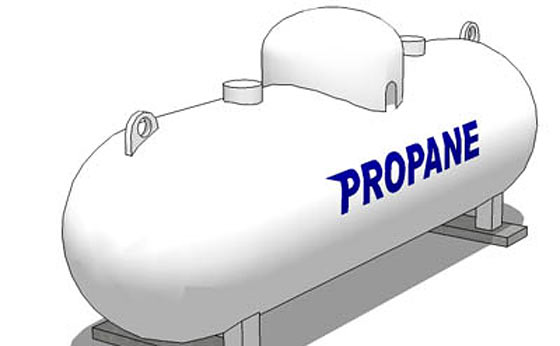
Off Grid Living: Propane Gas
I’ve recently moved and now have propane gas. I couldn’t be happier about it. Why? Because it is a stand-alone energy system that will provide me with heat, hot water, cooking, and whatever else I adapt to it. While it’s not my only energy source, it augments the others – and there is a certain peace-of-mind surrounding the notion of less reliance on external systems.
While my propane tank does require refilling, and is still a ‘dependent’ source, 1,000 gallons will store quite a-lot of energy – which can last a long time…
Living partially or totally off-grid-living presents its challenges. If you wish to maintain a standard of living in your home or retreat, and maintain a comfort level not terribly different from ordinary modern living, then one of your biggest decisions will be choosing what will be your fuel sources (plural) for energy.
You will need to answer questions like, What will I cook with? How will I refrigerate? Light my home? How will I heat my home? What about energy for appliances, the water-well pump, and everything else that ‘plugs in’?
There are many questions when you consider all of the modern conveniences that make our day-to-day lives easier. I believe that an approach of power diversification is the best consideration. Having multiple sources of energy will provide you a backup in some areas. If one source of energy is lost, then at least you won’t lose ‘all’ of your sources – and living conditions.
One source of energy that could play a significant role in an off-grid-living environment is propane gas. Unlike ‘natural gas’ which is often available in suburban homes from gas lines which are piped underground throughout cities and many suburban areas, ‘propane gas’ is stored in stand-alone tanks sitting (or buried) right on your property. The gas is piped into the home and is drawn upon as necessary until the tank needs to be refilled. It’s refilled by a delivery truck, similar to how an oil truck will deliver home heating oil for your furnace (if you have that type of heating system).
Propane is one of the cleanest burning fuels and burns with no soot and very few sulfur emissions. The gas evaporates quickly at normal temperatures and pressures, and is usually supplied in pressurized steel gas cylinders.
The most common tank (for typical portable home use – like a BBQ grill) is a 20 pound tank (also sometimes referred to as a 5 gallon tank). This is the kind of portable tank you would find at a Home Depot, Lowes, etc.
Related Article: How To Tell How Full (or Empty) Your Propane Tank Really Is
BBQ Tank Gauge
Propane tanks also come in larger sizes, designed for more of a permanent installation, and can be installed large enough to keep you supplied for quite a long time. Generally, 500-gallon tanks easily accommodate an average four-bedroom home while 1,000+ gallon tanks can fuel very large homes.
Propane can power most types of home appliances that we are accustomed to, so long as the appliance is designed for propane. Propane gas powered appliances include refrigerators, freezers, ranges, cook-tops, outdoor grills, room heaters, central heating, water heaters, generators, clothes dryers, and more.
Propane gas is measured and distributed in gallons, pounds and cubic feet, and is usually sold by the pound when dispensed into portable tanks, and sold by the gallon when weighing the tank isn’t feasible.
Propane tanks are typically filled to 80% capacity to leave room for expansion.
1 Gallon of Propane = 27 kWh (Kilowatt Hours) of electricity.
1 Gallon of Propane = 91,600 Btu’s.
1 Gallon of Propane = 4.2 pounds as a liquid at 60-degrees F.
1 Gallon of Propane = 35.97 cubic feet.
1 Pound of Propane = 21,810 Btu’s.
“How long will my portable tank of propane last?” This is easy to figure out if you know the number of pounds of gas that’s in your full tank and the btu/hr demand of your burner or other gas appliances. One pound of liquid gas in your tank has 21,600 Btu/hr fuel value.
If you have a typical portable 20# tank, and if you have a typical low pressure burner gas grill, for example that is rated at 40,000 btu/hr maximum output, then you can run that burner at full blast for 10.9 hours:
(20# x 21,810 Btu/# = 436,000 Btu’s in the gas in a 20# tank)
(436,000 Btu ÷ 40,000 Btu/hr = 10.9 hrs)
For off-grid-living, or to be more self-sufficient without relying solely on an electric utility service for most of your energy needs, consider using propane gas and appliances. If you are planning or designing an off-grid-living location or retreat, consider propane as an alternative energy source.
Good article… but beware of the “20#” tank exchange cages that are put in front of convenience stores, home centers, drug stores, etc. These tanks are usually not filled with a full 20# of propane any more. The signage on the front of the cage will state (sometimes in rather fine print) what they are filled to. 15# to 18# are quite common. Just another example of shrinking amounts of product.
Propane expansion bull! Heck 20years ago they were 20.pounders just another way to rip you off! Take it to a place that refills them
Exchange cylinders are fill by weight an not filled to the 80 percent capacity. Also note. Do not purchase a cylinder if the brass value has a tarnished blue appearance. Cylinders are used in making meth. They fill the cylinders with anhydrous ammonia . The dump the cylinders for Exchange. The ammonia destroys brass and the filling operation should take these out of service, but I personally have removed them from cages and informed employees to contact the supplier. Also, run a line directly from a large capacity tank to a backup generator to eliminate refueling. And propane can be used for interior and exterior lighting. Flame Torches can be used to kill weeds chemical free. Remove ice from equipment and more.
good advice Frank
I recently bought a new propane tank
and had it filled,they put in 4.5 gallons
the same day I had also purchased one of those prefilled exchange tanks
when I got home
I grabbed one in each hand to take to the shed
the prefilled tank was NOTICEABLY lighter
They don’t fill them because they say it needs room to expand due to heat.
I power my hole house with a dual fuel generator and I was getting my from IGA here in Bedford, Indiana and I ran into the same problem of sometimes the tank felt light. Pour a 15 lb propane tank powering my whole house gets me one day and 5 hours of non-stop running time on average, depending on what appliances can I use to cook meat refrigerator water heater xcetera. Sometimes when I would take a tank back to IGA and exchange it it would sometimes feel a bit lighter then the one before and I would only get about a little under a day worth of running time.it got to be such an issue IGA will not allow me to exchange my tanks there no more so I started going to Tractor Supply here in Bedford where I know that I get a full tank and I’m getting what I pay for.
todd mitchell
I picked up a really useful tip here at MSB a year or two ago, a 5 dollar fish scale. I use it to see how much I have left in a tank.
https://modernsurvivalblog.com/preps/how-to-tell-how-full-or-empty-your-propane-tank-really-is/
I also learned here that exchange tanks are filled to only about 75% full. Just another way to protect me from myself which I don’t need.
Famous quote from my Granny, “There’s a sucker born everyday and two to lick him.” I endeavor to not be that sucker.
I have been using a 20 lb propane tank with my grill for about ten years, sometimes for hours at a time. Yet, it never runs out even though it has not been filled in those ten years. I just cannot figure out why I never need more propane.
That’s easy, your husband is refilling the tank because someone (aka you) keeps running it for hours at a time and every time he goes to use it, it is empty…
Even the biggest plate of steaks isn’t going to take more than 30 minutes to cook them to charcoal! What could you possibly be cooking and for how many dozens of people are you cooking for, that leaves the grill running for hours at a time?
That made me laugh!!! Glad to have one of those hubbies that takes care of us!!
Oh,please send me one should you know of an extra!
yes,of course,stipulations apply….lol
Your Grill it’s probably plum into your gas…lol
@ Linda , this reminds me of a story that I heard sometime ago ( years maybe ), A guy bought a brand new VW beetle way back when they first came out. And he was bragging about how good of mileage he was getting, He stated that the gas gauge never moved at all, just fantastic mileage. What he didn’t know was that his friends were comin around at night and filling his gas tank with more gasoline, this went on for some time, and then he started wondering why he wasn’t getting the gas mileage that he had before. Again, his ” friends ” were coming around at night draining gas out of his gas tank with out his knowing it. This went on for sometime before he caught on. Never did hear what he said about his ” friends “.
I understand the logic of your propane tank, but for some reason, as long as I can remember, something has always worried me a bit about these large propane tanks (any size really)…
don’t they make a nice easy “all in one place” type of thing for the SHTF zombie type to cause trouble? set a fire? blow it up?
That’s why you don’t have them next to the house , but mine I put Hawthorn bushes/trees on 3 sides so you really have to go looking for it, and the delivery guy knows how to get into there , but everyone else just sees a bunch of bushes
Yes, leaving it out in the open can be a concern (someone crashing into it with a car, a wildfire burning through the neighborhood or a tornado/hurricane causing damage to it).
I don’t think many people would intentionally look to destroy it in a SHTF scenario, more likely they’d want to try and steal from it, though that would be tough without the proper hosing/connectors and likely a pump with power.
You’re best bet is to get it buried underground or conceal it in an outer building/barn. Delivery and install of a 1000-gallon tank is around $2000/$4000 depending on your location and whether you need the hole dug.
Hello,
I have some experience with underground LPG tanks. When buried the carbon steel tank is exposed to conditions that it is not designed for. The tank will corrode quickly unless special (and expensive) systems are put in place to prevent galvanic corrosion. The normal propane tank is for above ground use only.
FYI, they are built pretty robust so they should handle most problems.
Good luck,
Ray
If you have those kind of “acquaintances” you might want to bury it!
@ Anon, one idea that I had or thought of is to install a 1000 gal tank underground with the fill valve and gauge sticking up out of the ground, but still back in the tree line
100# tanks are still pretty common in rural areas too, and can be cheaper to get refilled (at a lower per gallon price) than the 20# tanks. We used them for years at our family’s vacation cabin to run the lights (mantle-type), stove, and frig. When I inherited it I had a 500 gallon tank installed and brought the 100# tanks home as backups. Save any regulators you find, like from old propane BBQ grills, and a propane repair kit with some 3/8″ and 1/2″ copper pipe, copper fittings, valves, pipe cutter, and a flaring tool might be a good idea too. Congrats on the new home Ken.
refilling portable Propane tanks.
A lot of places NOW Won’t fill portable tanks if you only have a Car.they want you to use open vehicle like a pickup-they claim it’s the law,Virginia,
I went to True Value Hardware NOT a problem. but I leave the window open any way.I do not put it in the trunk.
keeb.
The ones in my camper have never been an issue;except for getting them out to refill.
We always go to BJ’s and really they could care less.
I buy every used 100 pound tank I see on Craig’s list and get it filled. Have 2 Tri fuel generators, a 2k for keeping the fridge cold, vacuum the floors, watching a movie, etc, and an 8k for powering the well pump, doing laundey, taking showers, all the once a week stuff. Love propane.
Have the tank buried and run the to the house line underground
Propane tanks have an expiration date stamped on them.
They cannot (legally) be refilled until they are inspected and recertified.
You can fill a propane tank as long as the data plate reads 250 psi of working pressure , its propane cylinders that have to be inspected ect.. 20 pound grill bottles up to 100 pound cylinder need requalification dates ! If anyones has propane questions
feel free to ask and hope I can help. What I do for a living. Dave…..
Hi, i am connecting a 100 gallon tank to a small 80000 btu shop heater. it would not work with the two regulators one on the big tank and the one usually used to connect to small tanks so I removed the small regulator and not there is too much pressure for the heater.
please help.
-Steven
I ran out of propane and it was 3wks before I could get anymore. Just got 100gals today and delivery guy said it would take awhile to get through lines but it’s been 12hrs and still won’t let me light the furnace or water heater should it take this long?
How long after getting 100gals propane should it take to get into lines to the house…
About a day or so because when they deliver it it is in a liquid state. It needs to heat up and return to a gaseous state
It boils to gas immediately, and continues to do so as you use it. It doesn’t take a day to work through the lines.
You most likely have air in the piping if you ran out while operating equipment. Line will need to be purged free of air. If there is any air in the piping, the appliances will not light.
i have 2 100 pound cylinder propane tanks for my lil wall heater and was wondering if I could turn them both on so I’d make sure I won’t run out on the one tank? Thank u
If I run out of propane here (N.Calif.) and have it refilled there is a mandatory check made to make sure propane is getting into the home . water heater and furnace, before the service person leaves the premises. Safety issue’s.
I want to get a Generac generator for my home and use propane to fuel it. I fear a terrorist attack on our power grid. What do I need to know about this? I want to do this asap. Where do i go to buy the propane tank etc.
Thanks for being willling to help us novices. ;)
kathy
What you need to know depends if you will be installing it yourself, or not. Based on your question I assume you’ll hire someone so I won’t get into many details other than you need a large propane tank, an electrician to install the generator and make the electric connections, and a plumber rated to do gas to hook up the gas line.
Personally I don’t recommend large Generac generators anymore. My first backup installed 10 years ago is a 12 kw Generac, and during long outages I still use it to run my electric water heater and well pump, for 1-2 hours a day. But what they don’t like to tell you is how expensive they are to run. Mine uses a minimum 1.5 gallons per hour (it goes over 2 at full load), and since I don’t own my tank I’m at the supplier’s mercy on the price – often $4-5-6 a gallon at its peak. So at $4 if I ran it for a full day it would cost me at least $144. My entire utility electric bill averages $200 per month, for comparison. Propane has its advantages, since it doesn’t go bad and you can easily store a large amount with little hassle. But in a big emergency nobody is coming to refill that tank once it is gone – and you can’t hook up the generator to small 20-pound tanks to run it (usually you need a 250 gallon tank, minimum, to provide enough surface area in the tank to provide enough gaseous propane). They also provide “dirty” power – the frequency and voltage wavers slightly and you’ll notice it in your lights. So big Generacs are expensive to run, I forgot to mention very loud, have dirty output,and really only good for your “average” emergencies like ice storms and hurricanes. Fine for short periods running your well pump while you take a shower but you don’t want to run them for days on end.
Next I added a very large battery bank with an inverter. Lots of maintenance, and I couldn’t afford a solar array big enough to charge it properly. It was there to load shift. Generators run most efficiently near full load so it made sense to run it hard in spurts to recharge the batteries, then leave it off for 6-12-18 hours. It is also nice having the silence. Batteries are very expensive and they need lots of maintenance.
Next I modified my Prius so it would run the inverter I used with the battery bank. Now we hit the efficiency sweet spot – about 0.13 gallons/hour of gasoline to run pretty much everything in my house w/o conserving. When my big battery bank died I didn’t replace it because this worked much better – but this is also a highly technical solution that 99% of people shouldn’t even try. It was mostly for my enjoyment.
However, there is a solution that is just as efficient as the Prius – modern inverter-generators. The big name brands with proven reliability are Honda and Yamaha although there are cheaper alternatives now. Still too new to trust for long-term reliability, IMO. They sell them cheaper because they make them cheaper. Stick with the blue or red. Unlike the Generacs or the old-style contractor screamer generators, this new technology allows the engine to idle most of the time which saves gas and makes them very quiet. Usually even at full power they run slower than old generators so they are still quieter. They output perfectly clean power, sometimes cleaner than your utility. In your average emergency when you don’t need to conserve your house only needs a few hundred watts 2/3 of the time – to run the fridge, etc while you sleep or are at work. There are a few hours where it will need 1000-2000 watts, running everything while you are awake, and then spurts where it will need 5000-10000 watts to run the big stuff. So most of the time you only need a small generator. And, if you run out of fuel you can bring more home yourself (if you can find it – but at least the option is there). You do need to rotate out your gas stock every 6-12 months, so there is more hassle, but depending on your local codes you can store enough of it (20-30-40 gallons) to last as long as a big 250 or 500 gallon propane tank would have lasted running the big Generac. Also you can buy or convert yourself many small generators to run on a 20 pound propane tank.
Which brings me to my current recommendation based on my own experience. Buy a 2000-3000 Honda or Yamaha inverter-generator to run your baseline loads 24/7. After converting all lights to LEDs/CFLs, upgrading appliances like TVs to LED and fridges to modern efficient models, that is more than enough power to run just about all 120 volt loads in your house. I can turn on just about everything in my house while running my Honda EU3000is, and it only burns about 0.2 gallons/hour on average (about the same as the Prius). Let it run 24/7 (if you aren’t conserving in a big emergency). I only have to refill every 24 hours. Then also buy a large cheap contractor grade generator big enough to run your big loads, if you have big loads. It only needs to run for short periods of time when needed. It will act as a backup to the smaller generator, too. Pay an electrician $500 to install a hookup and transfer switch. Both generators will still cost far less than the Generac once you get a tank installed, etc. Figure $6000+ for the Generac vs. $3000 for the two portables. If I had to do it all over again this is what I would do.
Keep in mind you don’t need to run any generator 24/7 if you need to conserve fuel. A fridge/freezer will hold its cold, and in the winter a house won’t cool off to a dangerous level that fast. You can get away with running a fridge or furnace 1-2 hours, then off for 4-6 hours or even a full 8 hours sleep period once a day. Doing that will extend your fuel supply 3-4-5 times.
To give you an example of how a big propane generator compares with the double gasoline generator system I recommend, here is fuel use if you aren’t conserving (running 24/7). A 12 kw LP generator will use 36 gallons of propane per day, costing $144. If you have a 250 gallon tank it only holds 200 gallons when full (suppliers can only fill to 80% to leave room for expansion when it warms up), so at first you might think that would last you 5.5 days (200/36), but really as propane tanks get low under a high load the last 20-30-40 gallons may not be enough to produce enough gas to run the generator. So figure it might only last 5 days at a cost of around $700. Some fuel will be left in the tank. Over those same 5 days the Honda I have will burn 24 gallons (0.2 x 24 x 5). Knowing gas prices will go up again, at $3/gallon that is $72. Assuming the larger contractor generator runs 2 hours a day and burns 1 gallon per hour, over the same 5 days it will burn 10 gallons at a cost of $30. So a total of 34 gallons at a cost of $102. During a big emergency you can stretch those 34 gallons to last a month, easily.
Doug, Fantastic info! Thanks! Beach’n
Doug
Thanks for all your input. But I’m confused. I am going to move to a house that has an above ground propane tank that serves heat and stove. I think it must be about 1000#, about 5′-6′ x 3′ dia. From what I get from your post, I am better off having a gas generator for SHTF? Should I keep propane for only that for which is is now being used, stove and heat? Doesn’t the generator make so much noise anyone would know you are off grid? Should I get an above ground gas tank then to have as my back up, if there is no delivery available to power the generator? Do you have any experience in wind or solar power?
I want to move to this place and get completely off grid. Does anyone know how to find solar that can install without the ‘rebates’ where you hook up to your energy provider? Is wind po9er better and more reliable? I am in So. Tx. flat land, so not that much wind, but may still be an option.
Was your post for a particular name brand of generator or something more technical?
Hi Kathy, I have 2-500 gallon propane tanks one of which I lease and one of which I own. I got both of them from my local propane company.
If I had a 300lb propane tank hooked up only to my propane fireplace downstairs as a second source of heat. About how long would that last? Thanks
I assume you mean a 120 gallon tank, which weighs 300 pounds empty. Since they can only hold 80% of their rating, you have 100 gallons available. Find the BTU rating for your heater. The BTUs in a gallon of LP vary somewhat but you can use 91,500 as an estimation, which gives you 9,150,000 BTUs in a full tank. If your heater supplies 20,000 BTU/hr on its highest setting, you’ll get 457 hours on high – almost. As I indicated earlier, larger appliances need a minimum amount of surface area of liquid in the tank to supply enough gas, so when the tank gets very low you might still be able to run it on a lower setting but not on high. And of course if you run it at half output you’ll have over 900 hours.
SO, I bought this home and it has a 120 gal tank with about 35% propane on the gage.
There is a gas range with the home, however, does this tank need to be re-certified before having someone to agree to fill it up?
Thanks,
Don
You could call and ask the propane supplier that would be doing the fill-up.?
@ Don
I dont believe anything over a 100 pound tank needs to be recertification.
But I agree, call the local LPG joint
NRP
Hello Dave
My propane company has a very high charge during the winter months.
During the summer months the prices drop (in August) I have a 500 gallon tank and can almost go a full year without a fill up.
My tank is a 5% right now and I am worried I may not be able to hold out till August for the better prices.
I have a 40# tank that I purchased from Lowes ($99 killer price), that I would like to fill up and use on my house until the propane company drops their prices. What adapters do I need…??
If you purchase your 500 or 1000 gallon tank instead of renting it you can call all your local propane dealers to find the lowest price per gallon.
Also, the cheapest time of year to fill up is Jun-Aug.
That is exactly right – if you own your own tank, you will pay less. I just had my 1,000 gallon tank topped off today – for $2.29/gallon.
Some local propane companies pre-sell propane for the winter months at favorable fixed prices during the summer months. They aggregate all pre-purchase customer quantities and then ‘fix’ a price on the futures market for that quantity, add their margin, and provide delivery of up to that quantity from Oct 1 to Mar 31. Just bought 500 gal that way at a fixed price of $2.09 / gal!
When TSHTF, there will likely be no one to fill your tank. However, there will be plenty of full or partially full tanks around. (at least one in every back yard on the grill)In natural gas-less country, there is generally a 500 or 1000 gallon tank at every house. Get a liquid valve and learn to refill your own bottles. All larger tanks have a liquid access port. I keep two different kinds in our bug out trailer just for that scenario.
Thanks John, that’s a great reminder for us in natural gas-less country that raiders aren’t likely to be the stereotypical ones often depicted in SHTF books and movies. More likely, just a family or a couple friends with a bad idea.
Am sure was proposing as last/worst case…. I’d do same for me/mine! As I would hope you’d do….. hopefully we’d team up & restart……. God Bless
3 minutes without air, 3 days without water, 3 weeks without food… I forget, how long can we survive without propane Jeff? Parable of the Ten Virgins, you might want to read it again. God Bless.
Justin,I’m not advocating stealing from a neighbor. If there is a bad enough situation where you run out and the countryside is filled with abandoned properties, are you going to worry about ownership at that time?
Propane is very dependent on temperature to maintain pressure. Small bottles freeze up in cols weather. 100# bottles can be more efficient than 20#. Cold climates and propane aren’t always good friends.
Spent years on the farm in northern Canada running off of propane as a heating and cooking source. It has to get pretty cold (-40 is the same in Fahrenheit or Celsius) to cause a large tank to freeze up. What my father always did was run an extension cord out to the tank with a 100-watt bulb connected, then banked hay bales around the tank to block the wind. Anytime the temperature dropped, he plugged in the cord, and the heat generated by the bulb was enough to keep the tank from freezing up.
You are absolutely right! I have a 500 gal tank and I’m thinking of adding another. Don’t forget electric! I bought a 7kw standby generator with an automatic transfer switch. If the power goes out, a I’m back in business in less than a minute. 7kw isn’t enough for everything, but it takes care of the furnace, well pump, freezer ,refrigerator, and alarm system, plus 3 bedrooms.
How can I safely fill my 5 gallon tank used for grilling from my 500 gallon underground propane tank?
You must have a liquid line that attaches to a port on the tank. It may take a while to fill a bottle from an underground tank because of the cooler temperature underground. Ask your driver that delivers your propane. I bought my liquid line valve from the installation crew the last time I switched suppliers.
refilling for the grill is easier if you just run a direct line to it if it stays in one place that way you only have to fill the main tank. Grill is always ready to go and no more trips to town .
All good conversation here. I’ve been slowly moving to more of a sustainable lifestyle than an ‘off-grid’ scenario. As a farmer there has always been a need for large volume of propane and electric generation. Recently installed a 20Kw unit that if both thousand gallon tanks are full would provide electric at half load for approximately 300 days. Yes, that’s an approximation and understand that a non-commercial grade Generac isn’t going to hold up to that usage. Of course I’ve stocked spare and repair parts for about everything for four maintenance cycles under normal use, so filter, oil, etc. are always on hand with the intention of bringing electric on-line for short periods to allow well pump operation, laundry, deep freeze, etc. We heat with wood so not a lot of issues there. The problem I’m finding is cooking with propane in a non-electric state. Seems you can find a propane range with spark/battery ignition, but they are virtually without features. I enjoy working towards a reduced energy foot print not as an environmental wacko, but to reduce personal resource throughput, be it cash, diesel, propane, cattle feed, wood, etc. And I don’t mind spending top dollar for a highly reliable propane stove that actually looks good in a farm kitchen…but they don’t seem to exist. Have looked at Peerless, GE and Unique but seems a combination of a backsplash with clock/timer, full cast iron grates and battery/spark ignition is unobtainable. If anyone out there has solved this, and I mean for real, not a link to a brochure but has one in service, I’d love to hear about it.
Thanks
We are on propane @ our acreage. Purchased an off-grid propane stove, nice looking white Unique stove with a window for just over $1300. Excellent stove that has battery ignition.
Hey Saskies. I too live off-grid in the lovely, but challenging province of Saskatchewan. I love using my wood cook stove in the winter, but I really need to find a propane stove for the summer months – have been using the old three burner I pulled out of my old camper, and it works, but I’m ready for a nice full size one now. You’ve piqued my curiosity regarding your stove. Whenever I see a decent used propane stove it always seems to have the modern digital components. Barring finding a sweet old one at an auction, I might have to consider looking for a new one. Would you mind sending a link for where you found yours? Thanks!
Posting a reply in case you happen to have this thread set up to email you… Anyway, your 20 kw genset will last you more like 32 days. Two 1000 gallon tanks gives you 1600 gallons fully filled, 20 kw genset uses 2.08 gallons/hr on LPG at half-load, so 1600/2.08 = 769 hours or 32 days.
I’ll add that is running 24/7. Since you really only need to run 8 hours a day to keep a fridge cold, you could stretch that to 90+ days running part-time.
This seems like a good place to use batteries. Generators use gas whether the electricity is needed or not. Don’t think that a fridge runs all that much if the door is closed.
I agree there are alternatives, although I’ve been through the “large battery bank” treadmill and would stay away. I maintained 16 deep cycle FLA batteries for years and it wasn’t fun. Today I recommend a 2000-3000 watt inverter-generator for base loads, and a 6000-8000 watt cheap contractor screamer for a well and/or electric water heater. It also acts as a backup for the smaller generator.
If the worst happens you won’t need to power a fridge and/or freezer for more than a few weeks, after that powering a well pump for 10 minutes a week(just enough to get drinking water for the week and draw a bath) will be the biggest priority.
The way I understand it is that all of the newer natural gas ranges are easily converted to propane with the help of a kit that switches out the gas outlet with a propane one. I guess I’ll be finding out soon myself.
I have a Premier Stove P36S348BP that runs on propane, and while searching for extra parts I noticed quite a few people from 3rd world countries (that have electrical power failures “DAILY”) commenting on my stove. Seems my stove does not need “constant” electricity to function, and could be lit via a match. I am assuming once the oven pilot is lit it stays on till the oven is shut off.
The quality of the stove is fair (I could not afford a Viking, or Thermador) in fact you will probably run across my reviews from years ago.
My model# is discontinued but the newer models still use the same engineering (I think)…Good Luck
I have a question that I am hoping someone can answer. I have 2 Mr. Buddy ventless propane heaters for my off-grid home. Each are connected to 20 lb propane tanks. Would there be any reason why I couldn’t have 2 100 lb propane tanks delivered and hooked up to each of them? It is a pain to have to change out the smaller propane tanks.
Thanks
Holly
you just have them set it and have some one you know hook them up
Thank you!
a 100Lb cylinder will not run those appliances properly.
I am going to explain how a propane container works so you fully understand why the size of tank is important. when everything is turned off, you have liquid propane in the tank with a vapour space above it. The temperature and pressure inside create a balance so everything is static. Once the appliance turns on, you begin to draw off propane vapour and burn that. This reduces the pressure in the tank and the liquid propane begins to boil to replace that vapour. Propane boils at -44°F. So as it boils it is dropping in temperature. A propane tank has to be of sufficient mass to be able to absorb enough heat from the tank itself and the air around it to maintain this liquid boiling. If the tank is too small, it will simply “freeze up” and starve the appliance(s) for fuel.
So you see, a propane tank is not just a storage device. It is also a vapourizer. As the ambient temperature drops the capability of the tank to produce vapour also drops.
A 500 gallon tank at 33% and 0°F can produce about 300,000 btu’s of vapour. A 100lb cylinder can only produce about 40,000 btu’s at that same temperature.
The absolute smallest tank you could consider is a 100 gallon. These are about 3 feet wide and 4-1/2 feet tall. That will produce enough btu’s for both appliances as long as it doesn’t get below freezing and you keep it relatively full.
The regulator is sized to the appliance load, not the storage container. You can use the same regulator without changing any piping or anything.
Source:
23 years experience in the propane business and a licenced gas fitter
That is the best explanation that I’ve heard about this. Thank you for sharing your knowledge. I suppose this is also a good reason to have one’s tank buried if applicable with the design (a more stable ambient temperature), especially if expecting very cold outdoor temperatures. I have a 1000 gallon tank – and I’m glad it’s buried ;)
I have a cabin off the grid with a couple small tanks. I want to have a large tank at the top of a hill. My cabin is on a lake and one has to walk down a path to get to it. I want to install a gas heater, so I do not want to have to keep dragging down the smaller tanks. So, I have no idea how deep one must bury a gas line to make it legal. I am assuming one has to have coated copper lines. True?
Hi just moved in place and its run by propane and I can’t pay to get the big one filled up so I have a 4 and a half gallon tank I was told that would last me a month but only last two weeks give or take how do I keep it from running out so fast and its cold out
Had a prefab cabin delivered to my off grid land. it came with high quality low energy “Whirlpool” kitchen appliances. The refrigerator was the first to go, the computer controlled energy management system could not handle the switching between solar and generator. Replaced it with a basic model and it works fine. Now the gas range has gone out. can lite the stove top burners with a match but there is no way to lite the oven. electronic safety interlock will not let it lite.
Anyone know of a way to bypass or convert to a pilot system?
Consider switching to a marine (boat) type stove. Affordable used, look on eBay in the eBay motors section under boat parts. I’m presuming if you are off grid using a gas stove that it is propane.
Stock spare O rings. Also from what I understand propane valves don’t work like faucets. You can’t ration your propane by just opening the valve a little bit. They need to be all the way open or shut tight. yopropane, please correct me if I’m wrong on that.
I’ll tell you what… Me and my wife Peggy like the taste of food grilled over propane and even with my narrow urethra it is the best. All those commies that burn charcoal and ruin the environment – why it is a crime, I’ll tell you fer sure……..
i have different question but still related to propane gas, i have gas stove top / burner (six) in the kitchen , but since I’m changing it to electric induction stove top, i was wondering if i can use my old gas burner and transfer and use it in my outdoor kitchen and hook it to a propane tank (#20). The gas source from the kitchen is installed in the house when it was built i don’t know if i can hook it to a regular tank source.
Curious,those of you who use propane for home use (heat,hot water,etc) about how much do you spend annually?
I almost always see the same size propane tank in peoples yards.What size are these tanks?
Thanx Ahead.
Tim.
@Tim, I have a 1,000 gallon (buried) propane tank (which is considered ‘full’ at 80% or 800 gallons). It currently is my sole source for heat, hot water, stove/oven, and a clothes dryer. Average size home (well insulated) living in northern NH where it gets pretty darn c–c-cold during the winter. This first full year here, and with a horrendously cold and long winter, we consumed nearly exactly 800 gallons from July to July. Hope that helps…
P.S. I am planning to add a ‘modern’ efficient wood stove for the sake of preparedness (and some supplemental heat – as well as that warm cozy feeling on a cold snowy night ;) )
@ Tim
Most of those “yard” tanks are either 250 or 500 gallon tanks, They will also only hold 80% as Ken’s buried tank.
I have a 500 tank, I have two wood stoves that burn about 3 cords of wood a winter. I’m in the Four Corners, so the winters are not so bad (3-4 months of cold to very cold). Anyways I fill around 50% every other year, so I use around 125 gallons a year for Gas stove, Furnaces, Water-heater, Backup-In-Floor-Heat, and an outside BBQ hookup.
FYI, my cost on propane now is right around $1.85 per gallon delivered.
I’m cheap and don’t like buying Propane…. HAHAHA
NRP
Hi, thanks for the article but I have a few question.
I’m wondering how much gas you think you would need for a medium sized house for one year?
How long does the propane last for before it expires?
Can underground tanks be refilled underground or do they need to be dug up?
I’m putting together a plan for a bug out location and am trying to find out as much as I can before I buy anything.
Thanks
-James
Note, this is for the UK, so it gets cold.
@James, here are my answers to your questions:
Q. I’m wondering how much gas you think you would need for a medium sized house for one year?
A. I have a medium sized house (apprx. 2000 sq. feet) and I use about 800 gallons of propane in a year, and I live in a cold climate in northern New Hampshire (Heat, Stove, Oven, Hot Water, Clothes Dryer). If I conserved by lowering the thermostat, I would use less.
Q. How long does the propane last for before it expires?
A. Propane does not have a shelf life – which makes it a very good choice for a long term fuel choice. No expiration.
Q. Can underground tanks be refilled underground or do they need to be dug up?
A. No need to dig up – they are refilled at the surface by way of its design.
Thanks for your reply.
Hi. Can three 40 lb. propane tanks be hooked up so that as one runs out another is activated and then the third as the second runs out ? Currently using a unit on two 100 lb. tanks. open both tanks and a red to green indicator lets us know when one tank is empty. All automatically.
Nice thread, some answers are very valuable, especially I appreciate detailed post from (yopropane says: November 13, 2014 at 6:17 PM).
My question is if somebody can help about a propane heater. How it works when there is no electricity and so no blowing fan. How air gets circulated over a house? Thanks!
Convection, the hot air will rise and colder air will move in to replace it.
Place your heater as close to the center of the house as you can and open all the inside doors so the air can move into other rooms.
You will have uneven heating but it is better than no heat.
A great thread. I just got a dual fuel Champion. Champion said I could use a 100 lb. tank if it set it by the generator, but if, as I intend, have a plumbed copper line, I need to go with a larger (1/2″ ID) tubing to get the adequate water column. I have four 40 lb. tanks and planned to get a couple of 100 lb. tanks, put them behind the shed housing the generator (yes, I will pull it out to run it), and have the tubing run through the shed, and have a 10 foot flexible hose that then connects to the generator. I would then rotate tanks as they empty. Does this sound workable? I wanted a 120 gallon tank but the propane company hose won’t reach.
Another question–anyone found an alternative to a concrete pad–plastic, for example?
Thanks!
I have an rv and high temperatures are about 26 degrees. I ran out of a 5 gallon propane tank in two days.I am not cooking or heating the hot water tank, just the furnace. Is this right?
@Sheryl, yes, that would not surprise me. Most RV’s have little to no insulation. I have a 5th-wheel trailer which does have ‘some’ insulation (only about 1″ thick between inner/outer walls) and it too will go through the propane (heat) during cold weather. It’s always winterized during the winter – and I cannot imagine how much propane would be consumed this time of year if I were to use it… ouch.
I agree with Ken’s reply. Little insulation and low temps will make you burn through propane quickly. If you have electric hookups use 1 or 2 electric heaters.
I use a 100 gal tank to feed a ventless heater. In an emergency can I use 20lb “grill tanks”? Do I need special fittings?
@ Scott
Nope, should be the same fittings
NRP
Can I use the regulator from my 100 tank for my 250 tank. It will feed to a five grate heater.
@ amber
If the 100# tank/regulator is currently running the heater, that the tank size is not a problem. Same pressures, same fuel, same volume used by the heater, just a larger tank.
NRP
I am considering buying a standby 10K generator for emergency purposes only to provide energy for an all electric home of 2500 sq. ft. This would include a 40 gal. hot water heater, stove, frig, microwave, a tv, computer, and a stair lift. I suspect we would only heat about 1000 sq ft.at a time. How much propane would we consume per day?
I use propane for cooking and hot water. Should I leave the tank almost empty or almost full if I do not use propane for six months of the year? Thanks.
dave
hopefully someone here is more informed than I,
but I have always heard that it is
safer to leave these tanks as full as possible..
-the fuller the less chance of accidental explosion (apparently a full one is less explosive than partially or entirely empty one)
-the fuller, the less chance of moisture or condensation build up with any temp change
@dave, Propane doesn’t ‘go bad’, so from that perspective it doesn’t matter.
Im curious, if i have an underground propane tank, and there is no electricity for whatever reason, can i still refills smaller tank (20lb)? Do the refilling process need some sort of electrical pumping system?
@ kingasas33
If you have a “wet hose” on your tank, yes you can fill smaller bottles.
Check with your Propane Supplier, some areas you cannot have them.
NRP
Cabin in N Wis. with empty house heat only from pilot lights. Cook stove pilots stay lit (no thermocouples) but space heater pilot goes out when temperatures get low and refuses to stay lit until room temperature gets warm from what is supposed to be a supplemental wood stove. Thermocouple has been replaced more than once.
We like to go there in winter but are too old to wait for 16 hours for 65 F. The wood stove takes that long. Any suggestions?
martin
increase the insulation, etc, so it takes much less to heat up/keep warm.
also
to tide you over until it heats up….
some “newish” resources.
-battery heated socks
-battery heated vests/jacket/gloves etc
Once house is below 0 F it takes a lot to even warm the walls inside the insulation and hunters’ chemical heat packs over the bodies of 2 elderly people is as expensive an option as enough batteries. Thanks anyway.
martin
not chemical packs..
battery operated
have seen these in socks, and much else, including vests/jackets/hats.
have known people who were easily chilled used these in very very cold, to great success.
I am thinking back to when I was a kid on the farm, (oh a hundred yrs or so ago)…no electricity, no propane etc. All wood heat.
what we did, way back then, was goose/duck down/feather comforters. (homemade by my Mom, so not so much like purchased ones these days). Two to a bed/small room, even better (and you have that).
also, if you can close a door on one very small room, to occupy/sleep in, till the rest of the cabin warms up
also, if you do not have a small room, if it is more or less all one,
have seen this idea used (in articles read), and apparently it works quite well.
Pitch a small tent, just right size for you two, in the cabin. Down, feather quilts on bottom, snuggly sleeping bag for you two to crawl in. Toss in some of those battery operated socks/hats/vests, to wear, and it might keep you both comfortable enough, until the main cabin warms.
Also, in the tent, toss in couple thermos of hot beverage, sandwhichs, or maybe hot stew in thermos, or hot porridge. Bet it could work.
I just moved into an all electric house this month. I want to use propane heater/s as emergency backup. I have several BBQ propane bottles and one 100#. How do I connect them to the portable ventless heaters. Where can I have the propane located safely while attached to heater, against my house, inside the garage or are there codes for safe distance from house?
Does anyone know where I can purchase the fixture, that will allow connection for liquid extraction from a 500 gallon tank? Is there an online source?
I understand this fixture is used by the gas companies to evacuate the gas in liquid form if it needs to be moved.
My intent is to have a “wet line” to refill 20lb, etc. tanks.
I would appreciate any help.
stinkygas,
I’m going to guess that no new ones are being made, due to EPA reg’s for gas release into the atmosphere. You might try an independent propane retailer, who may be talked into selling one off an older tank. Tell them you’re looking for a “wet stab” and filler hose. Might also try farm auctions. Not unusual to see them sell old tanks, and many come with that installed, as many farmers in the past ran tractors on propane/butane and filled them from the larger storage tanks. Been a while since I’ve been to one of these auctions, but last I did, you can expect to pay $1 per gallon capacity.
Hope this helpful.
@ stinkygas
Contact your Propane Supplier, they may or may not allow a “wet hose” on a tank they fill.
My neighbor has one that they installed; another local company will not install if it’s a rented tank, but will if you own it…
NRP
Here is data that I searched high and low for:
Propane wet leg (line)
Quote : “””””I do believe Ebay deleted my response. Yes the valve reads 7590U (500 gal tank) my 250 gal tank valve states PV623B,
“use PV903 unloading adaptor only”
What is the auction number for the item I need.”””” end Quote
I have 1 500 gallon tank for my house, and a 250 gallon tank for my pool (two different suppliers) with two different types of valves.
I bought a 9Kw Champion Dual Fuel Genny from Costco that I will “only” run on propane (no having to start it every month to keep the gasoline from gumming up).
I was getting ready to pull the trigger on a “WET LEG” (appx $200 on ebay) but when I built my house I installed a 3/8 flare on the outside of my house (where I thought I was going to place a huge BBQ).
I called my propane company and asked if my 500 Gal house regulator would supply my Generator They said my house regulator (500 gal) has a 990,000 BTU (almost 1 million BTU) rating.
My Genny needs 150,000 BTU (1 tenth of a million) (I forgot the spec 150,000 BTU ???) My house regulator supplies “more” than enough BTU’s
So I bought a 60′ SS hose that fits my house nipple, and my Genny nipple (tested under full load works fine).
I also have a fire pit (propane), by my pool that uses a separate propane tank (250 gal) that runs my pool, and spa heater. I removed the fire ring and installed the 60′ SS hose on it and ran my 9K genny under a 85% load (Vornando heaters) just fine.
Your answer is on EBAY use the term 7590U (most popular) Do not tell your propane company your intentions, after all God certified THEM not YOU! to handle propane, and they may refuse to service you.
Disclaimer : I am not responsible if you blow yourself up..!!
Please do not attempt to run a wet line if you are below average intelligence (75% of the population) or were born after 1991 (millennials are not that bright).
Good Luck
Propane Companies are insured (like any other company). They give us some guidelines of what they will cover and what they will not in the event that an accident occurs. We are trained and are to follow the guidelines of NFPA 54 & 58. This includes installing “wet-legs” (liquid transfer hoses) and training the person (or people) that will be transferring the fuel. There is a 1MM dollar liability insurance requirement that goes with it. If there is an accident caused by them then their insurance takes the hit 1st before the propane suppliers insurance. Most propane accidents occur due to “operator error” by someone that is not trained nor even remotely familiar of what is needed, how to install and / or operate it correctly. Sorry, but most propane companies can’t afford to take the hit and or lose their insurance (which would put them out of business) for the sake of looking the other way for a quick sale.
If it’s any help then ask someone who works for a propane company for “what would work”. Thanks
I’m not finding any information on what seems to be a reasonable question. Hopefully I will find something here. I would like to heat my garage with the same heat I use to boil my strike and sparge water (home brewing enthusiast). It might happen by either converting a square high pressure propane burner for indoor use (less likely) or using something like a Propane Convection Heater (e.g., Mr. Heater) and stabilizing to support a 10 gallon kettle. Does anyone have any thoughts or experience? Yes, I would only do this with a heater designed for indoor use, with a fresh air source and a CO/inflammable gas monitor on small projects for limited times.
@ dual use possible?
I have been brewing for almost 26 years….. Open the door, and heat after you kill the burners, use a propane heater designed for indoor use…. The risk is not worth the results.
FYI a Mr. Heater will not get the temps you need for the Sparge or the Boil
NRP
PS; been there, tried that…. :-)
I have a question that will probably seem really stupid to most of you who frequent this blog. My boss recently bought a cabin in a rural wooded area. She’s having all the renovations done by a handyman, not a contractor, which seems nuts to me, but she’s the boss. She asked me to research a bunch of stuff for her. I’m totally clueless. She told me that all power for her new cabin is going to be supplied by a propane generator. Since this blog deals with folks who are using exactly that to fuel their homes, I’m hoping someone can answer my question. She asked me to research best prices for propane fueled wall heaters, where to buy them, etc. I’ve been searching on line, several retailers, including Home Depot. The heaters I’m finding seem to have their own propane tanks. But my boss told me that she wants me to find her wall heaters that will run off the large propane tank that they are buying. So does anyone know where to buy those type of heaters? She’s also looking for a large freezer…same thing, that will run off of the propane tank. Can anyone clue me in here?
Thanks a million!
Clueless City Girl
I do know why she is under the impression she has to purchase a tank with the appliances from one dealer??!!
Usually you purchase the require household items separately, or as a group from whomever you decided has what you need. Find a propane dealer in her area that will set a tank to her requirements, and fill it.
Propane installation would be either the company she is purchasing the tank from or a “licensed contractor”, as the propane lines have to all be checked and pressure checked before the gas could be turned on to the appliances. Then each appliance is checked to make sure they are in proper working order. Hope this make sense to you.
You can locate a tri fuel generator that runs on propane/natural gas/gasoline, since she is requesting propane you may wish to check out Costco at this time. They have one on sale for $2,800, normally it runs $3,500, it is a 17kw with a transfer box for a 200amp service on a home.
You can also find a wall propane heating unit that will work without electrical service, has a battery operated thermostat to keep the house from freezing. We found ours at a travel trailer supply store, it has been a 20+ years but hopefully they are still being manufactured.
Sun Frost is a company that makes refrigerators & freezers here in the USA, they are strictly solar powered. If you check on line you will find refrigerator & freezers that will run on propane/natural gas, depends on the size your boss wants in the cabin. Check the reviews on each appliance before you purchase them.
Guess that should cover your questions to the best of my knowledge.
Clueless City Girl
Found the code for the generator in Costco #1102646 price is $2,899.
Simple answer.
Install standard appliances that require “gas” then “switch out the “”””orifice’s””” from natural gas to propane gas. I did this with my pool heater, my whole house central heating system, my stove, my water heater, my clothes dryer..you get the point. (W/H actually came with a propane orifice).
An orifice should be no more than $20 (thats a high price) and are very easy to install (Cake).
Good Luck !
Oh yeah ” refrigerators & freezers” are a different animal..they do not have orifices.
Can a camp stove be hooked to a 500 gallon propane tank for emergency situations? How do I know what size regulator to use on stove? Dixie
Dixie,
We use the hookup from a BBQ grill/ or smoker… of most of our outside cooking, the BBQ grill comes with the proper size regulator.. we have, 20/45/ 100 lb tanks right now.
BBq grill will also work/for canning, if it is the type that has an extra eye..it is almost fall, should be some on sale soon..if you have space for one…. we have small camp bottles and a refill kit from harbor freight to fill them from a 20 lb tank.. There should be a way to fill a 20 lb/45 lb from the 500 gal… but I have not investigated that. yet…small cannisters from wal mart/camping supply stores can be refilled….that are to be used with the campstove. I’ll have to check to see if it has it’s own regulator.. Ok, I checked our camp stove that is propane. it has a regulator hangin on it. but you are not going to want to cook on top of a propane tank.. the tank should have a built in regulator on top of it to dispense the propane to the house. Check with your supplier….may need to run a protected line to the area you want to use it, like on a covered patio?
What ever happened to those wood-burning home water heaters?
Info Please, thanks.
92-B,
I converted 3 discarded propane water heaters to wood burning. I removed the burner and thermostat. I built a rocket stove type design to replace the propane burner ring.The gas water heater already has the exhaust that goes up the center of the tank for any fumes/smoke. They use very little wood to heat up the water.
We installed all 3 for a large shower area for our group.A family all can take showers at the same time if needed. They also are hooked up to the community laundry area.
Just have to tend 3 individual fires if all 3 showers will be used.
My young grandson learned how to sweat copper on this project. He suggested that we install a recirculating pump between the 3 water heaters so only one fire would be needed.It works good but just takes longer to heat up 140 gallons of water.
They still have the pressure relief valves and hook ups for plumbing. Only difference is the heat source.
I got mine from a plumber who does warranty work for water heaters. He just stripped off the stickers and then they were considered recyclable.
Hope that helps.