
Best Cold Weather Extension Cord (SJEOW vs SJTW Explained)

A cold weather extension cord. There’s a significant difference between a regular extension cord and one designed to perform in cold weather. Here’s my up-to-date opinion for specific extension cords among the best for cold weather conditions.
The best cold weather outdoor extension cord is an SJEOW-rated cord because its thermoplastic elastomer jacket remains flexible in freezing temperatures, unlike standard SJTW PVC cords that become stiff and difficult to manage in winter.
I researched this because I use outdoor extension cords during winter, and I needed at least one cold weather extension cord—or two! I was tired of dealing with stiff, unmanageable cords, so I found a brand that I believe to be among the best for cold-weather performance.
The main difference is that the outer jacket remains flexible when cold and won’t crack.
Contents (Jump to a Section)
- What is a Cold Weather Extension Cord?
- Cold Weather Cord Jacket Ratings Explained
- Cold Weather Extension Cord FAQ
- Best Performing Cold Weather Extension Cord
Has this happened to you? It’s winter (or cold weather on either side of winter), and you need to use an extension cord outside, maybe for use on a job site or for whatever reason.
Once exposed to cold weather, it becomes stiff very quickly, making it difficult to manage. And when you’re done, it’s next to impossible to nicely coil it up for storage—because it’s so cold and stiff! A purpose-designed cold weather extension cord solves this problem.
What if you keep your extension cord in the garage, where it’s cold? Now you’ve got another annoying problem when you need to use it: unwinding or uncoiling it! The loops will not lay out straight because they are cold. They are not flexible, and they are not manageable.
Yet another example: You’re a contractor. Extension cords are in the truck all the time. Now, you have problems unwinding them and then coiling them back up when finished. It’s annoying, to say the least.
Due to these problems, a regular extension cord will eventually crack and break during cold weather usage. I’ve had that happen!
Again, a purpose-designed cold weather extension cord will solve this problem!
What is a Cold Weather Extension Cord?
Its design and construction have been optimized for cold temperatures—or, more accurately, ‘extreme temperatures’ (including hot). It is “All-Weather.”
A standard outdoor extension cord works well enough during the off-winter months. But it will probably freeze stiff during the winter.
When the temperature gets colder and approaches freezing, a standard cord will become stiffer and stiffer as its properties become less flexible!
This results in some potential dangers. Not only is it a pain to work with a less-than-flexible extension cord (good luck coiling it back up), but the cord might crack. Cords are unsafe when they crack because the wires become exposed and stop working.
A cold weather extension cord has an outer jacket and inner cables with jackets optimized to remain flexible. It won’t get stiff or crack and will remain durable, flexible, and kink-free.
Cold Weather Extension Cord Ratings Explained (SJEOW vs SJTW)
If you’ve ever wondered what the letters printed on an extension cord actually mean, they’re not random — they indicate voltage rating, jacket material, flexibility, and whether the cord is designed for winter or extreme cold.
When you’re shopping for a “cold weather extension cord,” the letter codes printed directly on the cord jacket actually tell you a lot. The two most common codes you’ll see for outdoor winter use are SJTW and SJEOW, and they are not the same when temperatures drop.
| Letter | Meaning |
|---|---|
| S | Service grade (standard 300-volt cord) |
| J | Junior (300-volt insulation) |
| T | Thermoplastic jacket |
| W | Weather-rated for outdoor use |
| E | Thermoplastic Elastomer (rubber-like, flexible) |
| O | Oil-resistant |
SJTW Extension Cords
SJTW cords use a thermoplastic (PVC-type) jacket, which is fine for outdoor use and wet conditions. They are durable, widely available, and a good match for general winter use, especially if the temperature is hovering near or above freezing.
If you’re using a typical cold weather outdoor extension cord for holiday lights, occasional tools, or short projects, SJTW generally performs well.
However, PVC becomes stiffer the colder it gets. When winter temperatures drop well below freezing, an SJTW cord will begin to resist uncoiling, will “keep its loops,” and may become difficult to manage or rewind. Over time, harsh cold can contribute to jacket cracking.
Best for:
- Occasional outdoor winter tasks
- Garage/yard tools
- Holiday lights
- Temperatures above 20°F
SJEOW Extension Cords
The game changes with SJEOW, which uses a thermoplastic elastomer jacket — more like rubber than plastic. The difference is immediately noticeable the moment you uncoil it in the cold.
An SJEOW cord remains flexible in freezing temperatures, lays flatter on the ground, and rewinds more easily. The enhanced flexibility reduces stress on the insulation and connectors, which is why these cords are popular among contractors, generator users, and anyone running snow-handling equipment.
This is the cord category that has become the best-selling extreme cold extension cord because its thermoplastic elastomer jacket doesn’t fight you when uncoiling or rewinding in winter temperatures.
Best for:
- Snow blowers
- Generator power leads
- Job-site tools
- Leaving cords outside
- Temperatures well below freezing (sub-zero)
In other words: SJTW works in cold weather —
SJEOW works nicely in cold weather.
Which Should You Choose?
The performance difference between SJTW and SJEOW shows itself the moment the temperature drops. If you’re frequently using tools outdoors in winter, the difference is night and day.
Since both cord types are available at similar price points today, the choice comes down to how and where you’ll use it.
| If you mostly… | Best Choice |
|---|---|
| Plug in yard tools occasionally | SJTW |
| Run holiday lights or inflatables | SJTW |
| Use a snow blower or electric snow tool | SJEOW |
| Use generators or power tools outdoors | SJEOW |
| Frequently coil/uncoil cords in the cold | SJEOW |
| Live where winter hits hard | SJEOW |
If you hate fighting stiff, frozen cords, then SJEOW is typically the smarter choice.
Cold Weather Flexibility by Extension Cord Type
Here’s a simplified, at-a-glance comparison of how each cord type generally behaves as temperatures drop:
Note: This chart summarizes typical manufacturer temperature ratings and real-world behavior for SJTW (PVC) and SJEOW (TPE) extension cords. Actual flexibility can vary between brands and specific product formulations, so always check the printed rating on the cord jacket.
| Temperature | SJTW (PVC) | SJEOW (TPE Elastomer) |
|---|---|---|
| 32°F (0°C) | Usable, slightly stiff | Flexible |
| 10°F (–12°C) | Noticeably stiff; coil memory | Flexible |
| 0°F (–18°C) | Very stiff; difficult to manage | Flexible |
| –20°F (–29°C) | At practical limit; may crack | Still flexible |
| –58°F (–50°C) | Not recommended / outside spec | Typical lower limit |
| –94°F (–70°C) | Not rated | Extreme SJEOW only |
PVC-based SJTW cords begin to stiffen as temperatures approach freezing, while SJEOW retains flexibility far into sub-zero conditions.
Cold Weather Extension Cord FAQ
The best cold weather extension cord is an SJEOW-rated cord because its thermoplastic elastomer (TPE) jacket remains flexible in freezing temperatures. Unlike standard SJTW PVC cords, SJEOW cords resist stiffness, coil easily in the cold, and are better suited for snow blowers, generators, and job-site tools.
SJTW cords use a thermoplastic PVC jacket that stiffens as temperatures drop, making them harder to handle in winter. SJEOW cords use a flexible thermoplastic elastomer jacket that stays pliable in freezing and sub-zero conditions, making them the preferred choice for cold-weather outdoor use.
Yes. PVC-based SJTW extension cords can become rigid in cold temperatures and may crack if repeatedly bent. An SJEOW cord is less likely to crack because its elastomer jacket remains flexible, reducing stress on the insulation and connectors.
Yes, most SJEOW cords are rated as all-weather and are designed for outdoor use in snow, ice, and freezing conditions. Always check the printed jacket rating to confirm temperature range and weather resistance.
Best Performing Cold Weather Extension Cords
There are several cold weather extension cord brands these days. After researching, I like US Wire (Extreme).
My Best Winter Extension Cord Recommendations
The following are SJEOW for maximum cold-weather flexibility and durability and are 12 AWG, my preferred rating for maximum power.
As an Amazon Associate I earn from qualifying purchases. There is no extra cost to you.
After dealing with frozen, stiff cords for too many winters, switching to US Wire’s SJEOW “Extreme” cord was a noticeable improvement. It stays flexible even when lying in snow, uncoils easily when cold, and winds back up without fighting you. That’s something a standard SJTW cord simply doesn’t do in sub-freezing conditions. For snow blowers, generators, and winter outdoor projects, this has been the most hassle-free and reliable extension cord I’ve used.
- US Wire SJEOW (25′) Most Popular on Amazon
- US Wire SJEOW (100′) Most Popular on Amazon

About US Wire: A veteran-owned company based in the USA. Their ‘Extreme’ extension cords are constructed of 100% TPE (Thermoplastic Elastomer), allowing maximum flexibility and rated in weather down to -94°F (-70°C).
If you are choosing one extension cord for winter, this is the type most people end up wishing they bought first. It’s easily one of the most popular cold weather outdoor extension cords for winter equipment.
“I bought this cord to accompany our electric snow blower. I wanted a cord that wouldn’t become stiff and unwieldy in Winter temps. This cord does the job well. Lying in snow and performing in single-digit temps has remained as flexible as my indoor cords.”
“It’s heavier to wind, but that is because it is 12 gauge wire to carry adequate load to my snow blower. Excellent choice, and the price was cheaper than other options!”
~ a review of this cold weather extension cord from a user
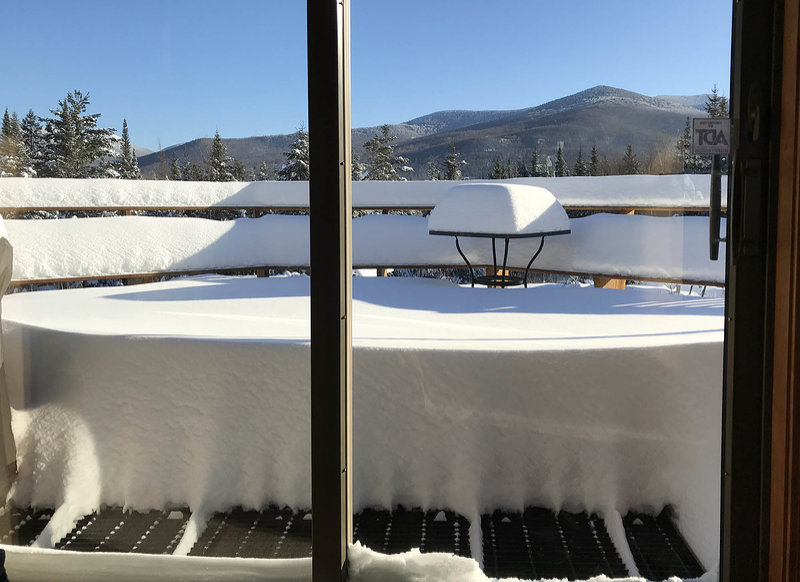
Like the reviewer above, I have an electric TORO ‘Power Shovel’ that we use only to clear snow on the deck. Mrs. J works the deck while I use a ‘real snow blower’ for the other cleanup. Here’s a photo after one particular snowfall (a bit much for the power shovel !).
The extension cord we used for the electric TORO for deck snow removal would immediately become brittle and stiff. Good luck trying to wind it up afterward—it was a pain in the @$$. That is, until we bought one of the cold weather extension cords!
[ Read: Extension Cords For Generators ]