
Best Geiger Counter for Preppers (2026) – Affordable & Reliable Radiation Detectors
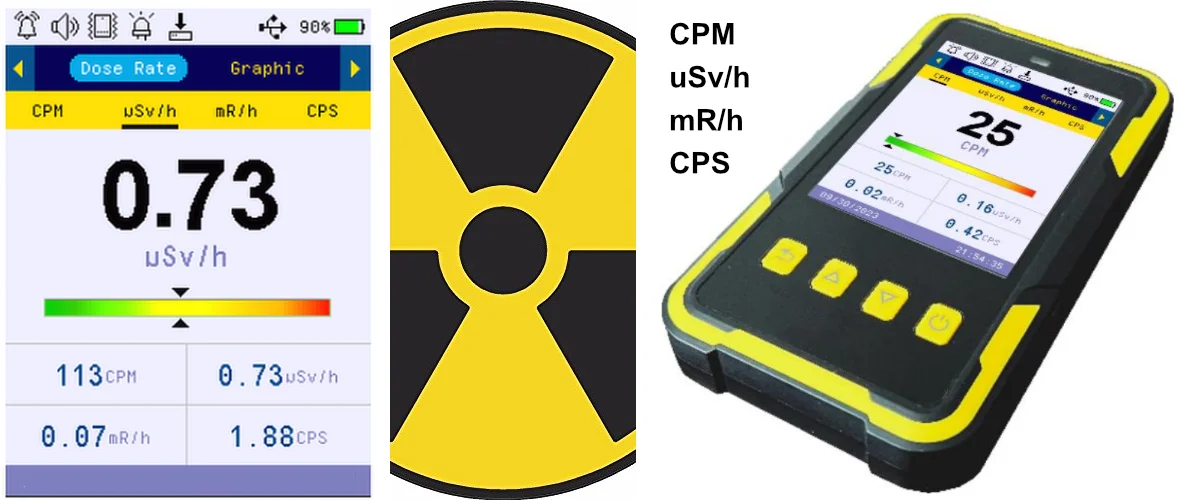
If you’re looking for the best Geiger counter for preparedness, you don’t need laboratory-grade precision — you need a reliable, affordable radiation detector that clearly tells you when radiation levels are rising and when they become dangerous.
In this guide, I’ll show you the best Geiger counters for preppers and home use, focusing on practical features that actually matter during an emergency: sensitivity, dosimeter capability, ease of use, and real-world reliability.
I’ll also explain what “normal” radiation looks like, how to interpret readings, and why some budget Geiger counters are perfectly adequate — while others are not.
If you want the best all-around Geiger counter for preparedness, I recommend the GMC-800. It offers multiple display units (CPM, µSv/h, mR/h), includes a true dosimeter mode for accumulated radiation exposure, and delivers excellent performance at a very reasonable price.
For those on a tighter budget, the GMC-300S remains a solid and reliable choice for general radiation monitoring at home.
Quick comparison of the best Geiger counters for preparedness and home radiation monitoring.
| Model | Best For | Dosimeter | Display Units | Radiation Range | Price Tier |
|---|---|---|---|---|---|
| GMC-800 | Best overall prepper choice | ✅ Yes | CPM, µSv/h, mR/h, CPS | Up to 2000 µSv/h | $$ |
| GMC-300S | Best affordable option | ✅ Yes | CPM, µSv/h, mRem/h | Up to 1000 µSv/h | $ |
| GMC-500Plus | Advanced logging & WiFi | ✅ Yes | CPM, µSv/h, mR/h | Up to 42,500 µSv/h | $$$ |
Jump down the page to:
👉 GMC-300S
👉 GMC-500Plus
👉 GMC-800 (great price point)
We are living in a world of uncertainty and conflict. Dangerous times. And lots of nuclear weapons.
We also live in a world partially energized by nuclear power plants. Though historically very safe, there are SHTF scenarios whereby this could become ‘problematic’.
A Geiger counter (also known as a nuclear radiation detector). In my opinion, it’s an essential tool for nuclear radiation preparedness. Every serious prepper should have one.
Should the unthinkable happen, it will be advantageous to have a nuclear radiation detector (Geiger counter). Why? Because radiation is invisible. A radiation detector will let you know whether or not you’re in danger.
Best Geiger Counter for Preppers & Home Radiation Monitoring
Features will vary to an extent. But I will address the important highlights.
When it comes to price, I have found that the detector itself, the Geiger tube (the part that actually collects / detects the radiation) makes a pretty big difference in performance (and price). It has to do with sensitivity, accuracy, and measurement speed. Though even the lesser expensive units are still adequate to alert you of dangerous radiation.
I primarily recommend GQ Electronics (reasonably priced) for a good general purpose Geiger counter and Dosimeter for prepping and preparedness.
GQ Electronics Geiger Counters
I’ve chosen GQ Electronics for the best Geiger counter / Radiation detector for general purpose use and monitoring (e.g. prepping and preparedness).
The GQ lineup is very popular and well-reviewed. They have really hit a reasonable price point for all of their models. They’ve been doing it since 2010 from Seattle.

It looks like GQ Electronics currently has 8 models, as of this update. I will focus on their most popular, best rated Geiger counters. Their GMC-300S, the GMC-500Plus, and their latest and very popular GMC-800.
GMC-300S – Best Affordable Geiger Counter for Preppers
As an Amazon Associate I earn from qualifying purchases. There is no extra cost to you.
→ Check Current Price on Amazon
(GQ Electronics)
The GMC-300S is one of the best affordable Geiger counters for preppers who want dependable radiation monitoring without spending a lot of money. It’s sensitive enough to detect rising radiation levels, includes a true dosimeter mode, and is easy to understand even for first-time users.

I like the product photo above because it shows several of the possible display screens.
micro-Sievert display units
I personally prefer leaving the display of a Geiger counter / nuclear radiation detector in the uSv/hr (micro Sieverts per hour)mode. It’s a unit of absorbed radiation dose and a standardized measurement method used around the world.
The standard unit of radiation dosing in an area is the micro-Sievert/hour (uSv/hr).
Just to give you an example of what’s normal radiation in my own area, my Geiger counter is currently indicating an average of 0.11 uSv/hr, which I believe is nice and low (a good thing!). You will get to know what’s ‘normal’ for your locale after a while.
Radiation Levels: How Bad Is Bad?
| Radiation Level (µSv/hr) | What It Means |
|---|---|
| 0.05 – 0.30 | Normal background radiation |
| 0.30 – 1.00 | Elevated but generally safe |
| 1.00 – 5.00 | Concerning — limit exposure |
| 5.00 – 20.00 | Dangerous — seek shelter |
| 20+ | Severe — emergency conditions |
Values are general guidelines, not medical advice.
Important: Radiation exposure risk increases with time. Even moderate radiation levels can become dangerous if exposure is prolonged.
I also explain radiation readings in more detail:
👉 Geiger counter numbers: how bad is bad?

CPM display units
If your radiation detector is displaying a CPM reading (counts per minute), that number will vary depending on the Geiger tube that’s in that particular radiation detector model. So this makes it difficult to readily or easily compare with others who may have different radiation detectors, or to talk about radiation level readings in a normalized way.
In order to do this, there’s a conversion factor for each type of Geiger tube.
Normalizing to micro-Sieverts/hour, a conversion must be made (or simply switch the unit’s display to uSv/hr – which automatically converts from CPM). This conversion takes place within the Geiger counter itself.
The GMC-300S uses the M4011 tube. The conversion factor for a GM tube M4011 is 151 CPM to 1 uSv/hr.
Dosimeter mode
Accumulated radiation dose over time. Potential tissue and organ damage from radiation. It’s influenced by the amount of radiation coupled with it’s accumulated dose over time. During ‘an event’, it will be important to know one’s accumulated dose. Very important!
Does the GMC-300S have a Dosimeter mode?
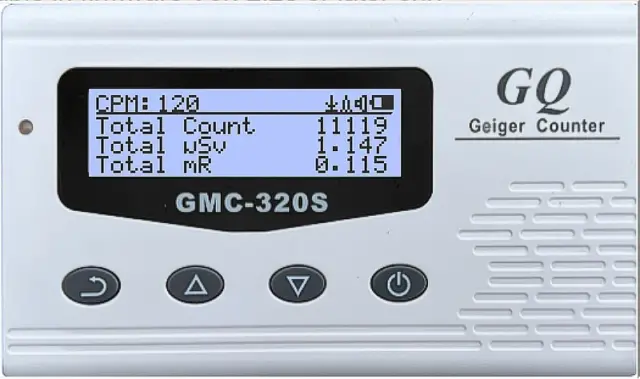
Yes. In dosimeter mode, you will see the accumulated dose in Total count, µSv/h, and mR/h.
Dosimeter mode example screen for the GMC-300S
Notable Features
- Detect and Measure β (Beta), γ (Gamma) and X-ray Radiation
- CPM, µSv/hr, mRem/hr
- Dosimeter mode
- Multiple display choices
- Mini USB Data port (and charging)
- Data logger
- PC software
- Onboard speaker and LED indicator
- Range of dose rate in µSv/h: 0.00 to 1000.00
- Range of dose rate in mR/h: 0.00 to 100.00
- Radiation Threshold Alarm (adjustable)
GMC-300S User Guide at GQ Electronics
GQ Electronics also host a live real time radiation map from users around the world who are submitting radiation data from around the world:
GMC-500Plus – Best Geiger Counter with WiFi & High-Range Detection
The GMC-500Plus is best suited for users who want advanced radiation monitoring, including high-dose detection and wireless data logging. With dual Geiger tubes and built-in WiFi, it’s capable of measuring radiation levels far beyond typical background exposure.
Choose the GMC-500Plus If You:
- Want automatic logging and uploads via WiFi
- Need high-range detection for extreme scenarios
- Prefer dual-tube redundancy
→ Check Current Price on Amazon
The GMC-500Plus has two Geiger tubes, the M4011 and the SI-3BG. The M4011 is a low dose tube and the SI-3BG is a high dose tube. In other words, this model can detect higher levels of radiation (0 – 42500 uSv/hr).
It also has built-in WiFi. It can log data via wireless WiFi connection and internal memory at the same time.

Yes. The Dosimeter mode feature was added in version 2.0

So, would I purchase the GMC-300S or the GMC-500Plus ?
Good question! If my main purpose were to log and upload data, I would likely choose the GMC-500Plus (WiFi). However for simply monitoring my environment, I do like the GMC-300S and all of its display features.
GMC-800 – Best Geiger Counter for Preppers (Top Pick)
→ Check Current Price on Amazon
The GMC-800 is my top recommendation and one of the best Geiger counters for preppers and home use. It combines affordability, excellent sensitivity, multiple display units, and a full dosimeter mode — making it ideal for real-world preparedness.
Why the GMC-800 Is My Top Choice
- Multiple display modes: CPM, µSv/h, mR/h, CPS
- True dosimeter mode for accumulated exposure
- Wide radiation energy detection range
- Simple interface that’s easy to interpret under stress
- Outstanding value for the feature set
GMC-800 User Guide at GQ Electronics
- Range of dose rate indications, µSv/h 0.00 to 2000
- Exposure dose rate indications, mRem/h 0.00 to 200
- Range of registered beta radiation energy MeV 0.25 to 3.5
- Gamma radiation energy, MeV 0.1 to 1.25
- Range of registered X-ray radiation energy MeV 0.03 to 3.0
- Gamma Sensitivity Co60 (cps/mR/hr) 22
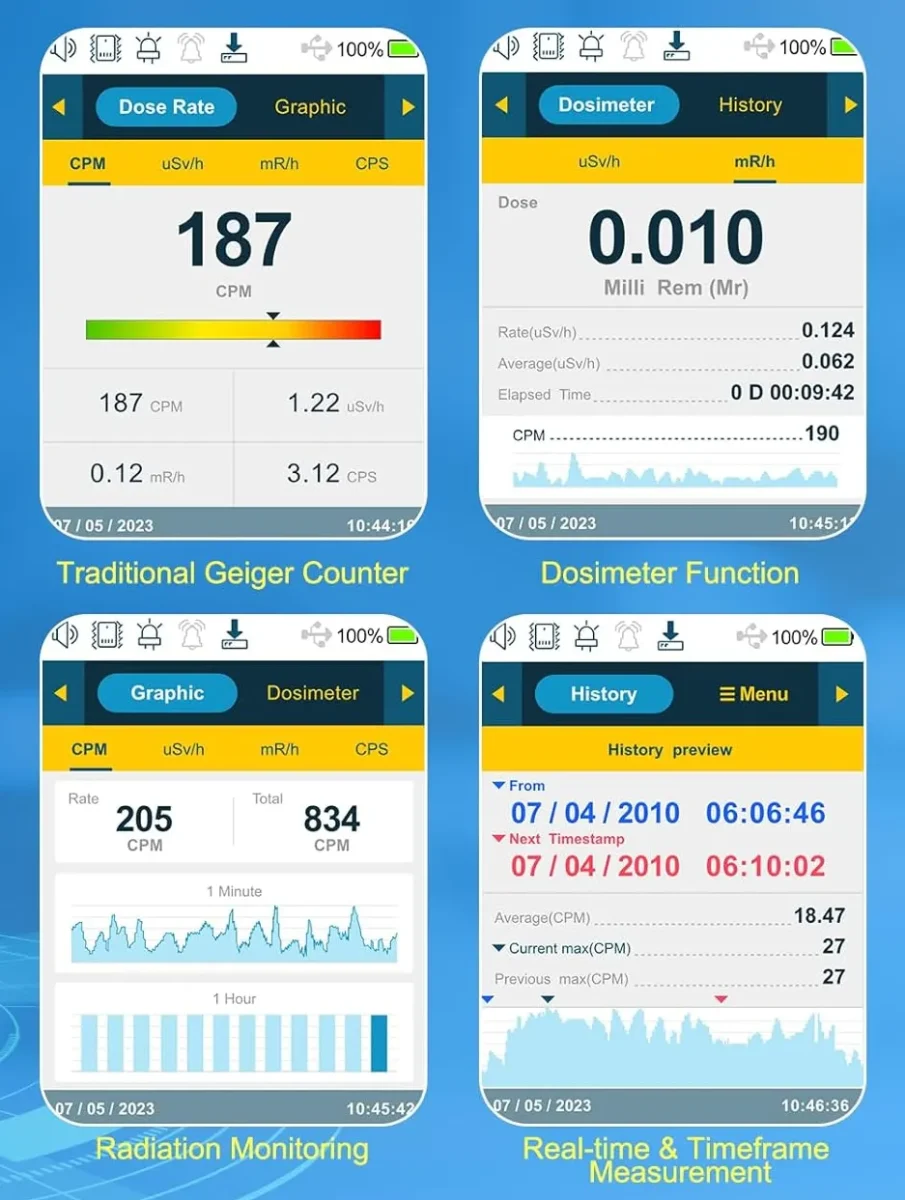
Here’s what the dose rate screen choices look like on the GMC-800…
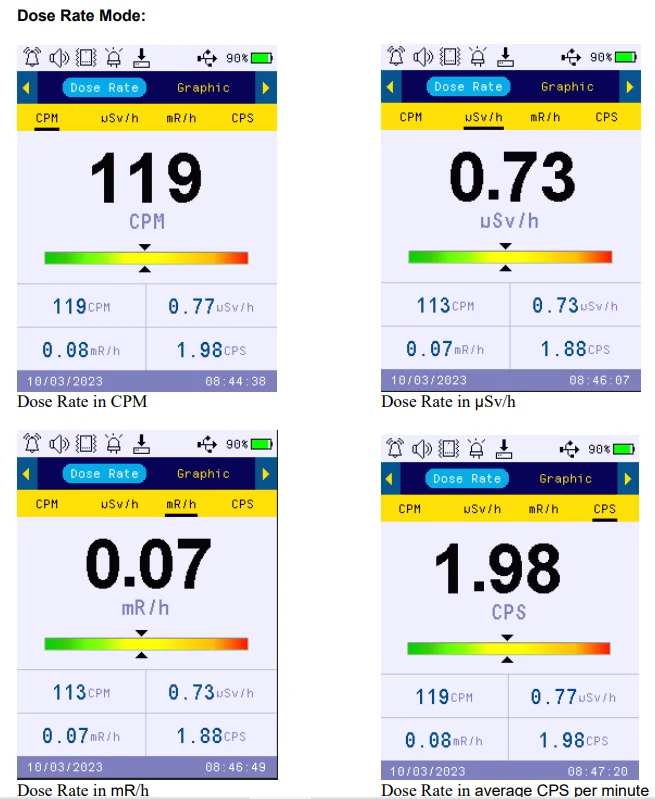
A view of additional GMC-800 screens…Dose Rate…Dosimeter…Graphic…History…
Geiger Counter vs Dosimeter – What’s the Difference?
A Geiger counter measures radiation levels at a given moment, while a dosimeter tracks the total radiation dose accumulated over time.
For preparedness and nuclear fallout scenarios, a dosimeter is critically important because radiation damage depends not only on intensity, but also on duration of exposure.
For additional protection planning, see my guide on gas masks for nuclear fallout.
All of the Geiger counters recommended on this page include a dosimeter mode, making them suitable for emergency preparedness and home radiation monitoring.
You may also want to consider iodine tablets for nuclear emergencies as part of a complete kit
Frequently Asked Questions About Geiger Counters
For most people, the GMC-800 is the best Geiger counter for home use. It provides clear readings in standardized units (µSv/h), includes a dosimeter mode, and is affordable enough for preparedness without sacrificing reliability.
Normal background radiation typically ranges from 0.05 to 0.30 µSv/hr, depending on your location. The important thing is to learn what’s normal for your area so you can recognize sudden increases.
For preparedness, absolute laboratory accuracy is not critical. What matters is the ability to detect changes and rising trends in radiation levels. Even budget Geiger counters are effective for this purpose.
Yes. Radiation risk depends on total accumulated exposure over time, not just momentary readings. A dosimeter helps you track this cumulative dose and make informed safety decisions.
Most consumer Geiger counters range from $60 to $200, depending on features like dosimeter mode, sensitivity, and wireless data logging.
Yes. A Geiger counter can detect increased radiation levels from nuclear fallout, helping you determine when it’s safer to shelter, evacuate, or limit exposure.