
BuddyBar Door Jammer Review: Does This Door Security Bar Work?

The BuddyBar door jammer is one of the strongest home security door bars I’ve used. It is simple, substantial, and designed to brace an inward-opening door from the inside. Here’s my BuddyBar Door Jammer review, with pictures, pros and cons, and a real-world look at how it works.
(Read a BuddyBar review from a police officer – below)
I’ve had the Buddy Bar for many years. I also have a less expensive ‘Master Lock’ Security Bar (linked at the bottom) which also works quite well. However, there’s one especially big difference between the two:
The first difference that I immediately noticed with the BuddyBar door jammer is its heft and weight. It is heavy duty!
BuddyBar Door Jammer Review: My Quick Take
Best for: Homeowners, renters, bedrooms, apartments, and inward-opening entry doors
Main advantage: Heavy steel construction, strong floor grip, no plastic weak points
Biggest caution: Do not overtighten it under the doorknob, because too much pressure can stress the door hardware
Bottom line: The BuddyBar is more expensive than lighter door security bars, but it is one of the stronger no-drill options for slowing or stopping a forced entry attempt.
BuddyBar Door Jammer Pros and Cons
Pros
- Heavy steel construction
- No plastic weak points
- Large rubber floor pad
- Stronger and heavier than many cheaper door security bars
- No drilling or permanent installation
- Good for homes, apartments, bedrooms, and nighttime security
Cons
- More expensive than lighter-duty door bars
- Heavy for travel
- Only works on inward-opening doors
- Can stress the doorknob or hardware if overtightened
- Still depends on the strength of the door, frame, and lock area

As an Amazon Associate I earn from qualifying purchases. There is no extra cost to you.
→ Check current price & availability for the BuddyBar door jammer(Amazon)
Table of contents
- BuddyBar Door Jammer Review: My Quick Take
- BuddyBar Door Jammer Pros and Cons
- What Is a Door Jammer?
- Do Door Jammers Work?
- BuddyBar Specifications
- How to Use a Door Jammer Correctly
- BuddyBar vs Cheaper Door Security Bars
- Limitations of Door Jammers (What They Don’t Do)
- My Hands-On BuddyBar Observations
- BuddyBar Door Jammer Real World Use
- BuddyBar Door Jammer Review from a Police Officer
- Frequently Asked Questions About Door Jammers and Door Security Bars
What Is a Door Jammer?
A door jammer (sometimes called a door security bar) is a simple mechanical device that braces a door from the inside. It wedges under the doorknob or handle and presses firmly against the floor, creating resistance when force is applied from outside.
Instead of relying on locks alone, a door jammer works by turning pushing force into downward pressure, making the door harder to open the harder it’s pushed.
Do Door Jammers Work?
Yes, door jammers do work, but with important caveats.
A quality door jammer like the BuddyBar can significantly slow or stop a forced entry by:
- Preventing the door from swinging inward
- Increasing resistance as force increases
- Buying time rather than guaranteeing absolute security
However, door jammers are not magic devices. Their effectiveness depends on:
- The strength of the door itself
- The durability of the doorknob or handle
- Proper installation and adjustment
In real-world terms, a “heavy-duty steel door jammer can turn a quick kick-in attempt into a noisy, time-consuming effort, often enough to make an intruder abandon the attempt.
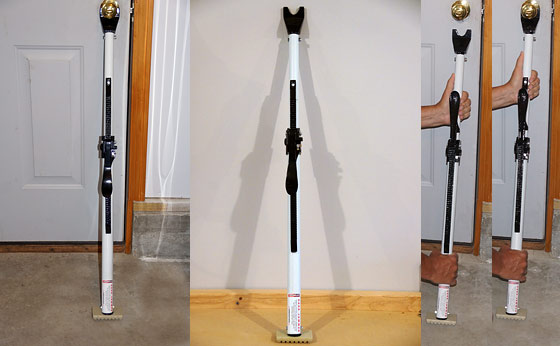
BuddyBar Door Jammer (heavy-duty steel construction)
BuddyBar Specifications
| BuddyBar Feature | Why It Matters |
|---|---|
| Steel construction | Less flex than lightweight aluminum bars |
| No plastic parts | Fewer weak points under pressure |
| Large rubber floor pad | Better grip on hard floors and carpet |
| Adjustable 36-51 inches | Fits most standard inward-opening doors |
| Heavy weight | Less likely to shift compared with lighter bars |
| Tested up to 2,560 lbs | Strong manufacturer claim, but still dependent on door/frame/knob strength |
How to Use a Door Jammer Correctly
Using a door jammer properly matters more than most people realize.
Basic steps:
- Adjust the bar length so it fits snugly between the doorknob and the floor.
- Place the top cradle under the knob or handle.
- Angle the bottom pad slightly away from the door to improve grip.
- Apply firm pressure — but do not overtighten.
Important tip:
Over-tightening can stress the doorknob or hardware. A snug fit that allows the bar to “settle” under pressure is ideal.
BuddyBar vs Cheaper Door Security Bars
Not all door jammers are created equal.
The biggest differences I’ve observed between the BuddyBar and cheaper alternatives:
- Material: heavy-gauge steel vs lighter aluminum
- Weight: significantly heavier, which improves resistance
- Floor pad: larger rubber base reduces slippage
- Adjustment mechanism: less prone to slipping under load
In a forced-entry scenario, mass and rigidity matter. A lighter bar may bend, slip, or shift under sudden impact — while a heavier bar resists movement more effectively.
| Feature | BuddyBar | Cheaper Door Security Bar |
|---|---|---|
| Best for | Primary home security use | Budget backup |
| Build | Heavy steel | Often lighter metal or mixed materials |
| Floor grip | Larger, heavier pad | Smaller pad, more likely to slip |
| Weight | Heavy | Easier to move, but less substantial |
| Travel use | Possible, but heavy | Better for travel |
| Price | Higher | Lower |
| My take | Better for serious door reinforcement | Fine as a secondary or budget option |
Limitations of Door Jammers (What They Don’t Do)
A door jammer:
- Does not reinforce weak door frames
- Does not replace quality locks or deadbolts
- Does not work well on outward-opening doors
Door jammers are best used as one layer in a layered home security approach, especially for bedrooms, apartments, or nighttime use.
My Hands-On BuddyBar Observations
EXCEPTIONALLY HEAVY DUTY!
The Buddy Bar is made of heavy gauge steel (rather than aluminum) and weighs more. I weighed it to be 7 pounds, 12 ounces. Whereas my other door security bar weighs 2 pounds. So the Buddy Bar is four times heavier! When someone is trying to bash in your door, it matters…
Large Footprint Floor Pad
A heavy duty rubber pad ‘sticks’ (wedges) strongly to the floor. It has a significant and a much larger footprint that eliminates slippage on the floor.
Heavy Duty Bar Adjuster
Very heavy duty adjustable length / latch. Although competing door security bars do adjust to an extent, the Buddy Bar method utilizes a very heavy duty mechanism which simply will not slip.
BuddyBar Door Jammer Real World Use
1. When using the adjustment lever for the first time and setting the initial length to wedge between doorknob and floor, don’t force it too tight under the handle. Too much force could actually damage your doorknob.
2. To set the length, I simply approximated the distance between the doorknob and about a foot away from the door at the bottom. Then I set it (latched it) without being under the doorknob. From that point on when I wish to use it – I lightly slip it underneath the doorknob (snug, but not too tight) and let it find its natural (pre-adjusted) distance to the floor.
So with that said, this door security bar is a simple but effective home security tool which will deter or prevent your door from being opened. Short of using a battering ram, it will help keep a potential intruder from quickly forcing the door open.
A few pictures:
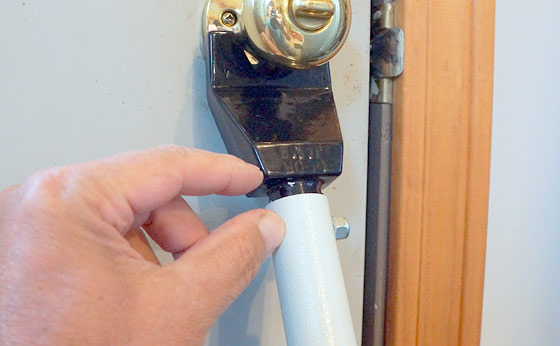
The ‘wedge’ that fits underneath the doorknob has about 1/2 inch of spring to it – which allows some ‘give’ while you wedge it under the knob. Makes it easier to set it.
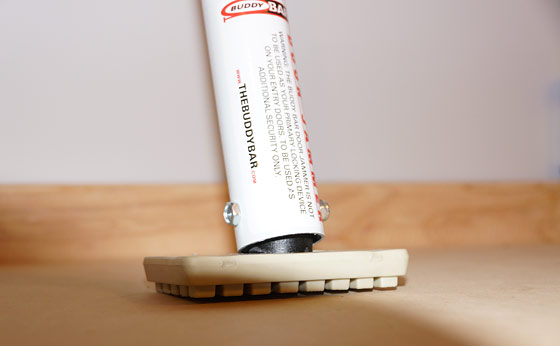
The substantial rubber floor pad of the BuddyBar Door Jammer grips very well. Even on shiny smooth surfaces, hardwood floors, tile, and carpets too.
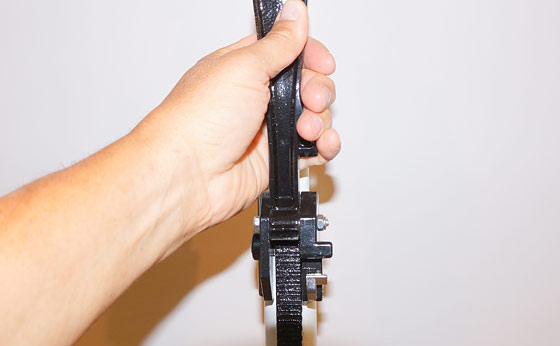
The heavy duty adjustment mechanism for height.
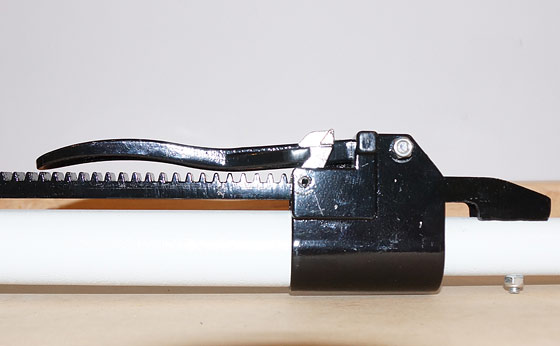
Side view of lever / height adjustment mechanism.
BuddyBar Door Jammer Review from a Police Officer
I’m a retired police officer. I did my homework. The Buddy Bar appears to be the strongest deterrent to a door-break entry, short of an expensive fortification of the door.
They are well made, heavy gauge steel and work on the principle of a wedge. The harder you push, the more resistant the wedge becomes.
I’ve had Buddy Bars for my front and back doors for four years now.
Like most security devices they won’t keep a determined intruder out forever. They are strong and well made, but they depend on the strength of your doorknob and door, because they wedge under the knob.
I think the door hinges would break before the Buddy Bar gave way. That said, short of an intruder having a police-type battering ram, they will give you time to get to a “safe room” and/or dial 911.
My daughter just bought a house. Three doors. I bought her three Buddy bars. A little pricey compared to the imitators, but what is your safety worth?
→ Check current price & availability for the BuddyBar door jammer(Amazon)
Frequently Asked Questions About Door Jammers and Door Security Bars
Yes, a good door jammer can slow or stop an inward-opening door from being forced open, but it depends on the strength of the door, doorknob, frame, and floor grip.
It can significantly slow or prevent it, depending on door strength and installation.
It can if it is overtightened. Use a snug fit, not excessive upward force.
Yes, it can work on carpet, but the fit and grip still depend on the carpet thickness, door angle, and how securely the bar is adjusted.
No, this style of door jammer is mainly for inward-opening doors.
In my experience, yes, mainly because it is much heavier, uses steel construction, and has a larger floor pad than lighter bars.
Yes. The BuddyBar is useful for apartments because it requires no drilling or permanent changes, while adding an extra layer of security to an inward-opening door.
Used correctly, they should not. Over-tightening is the most common mistake.
A less expensive, lighter-duty alternative to consider:
→ Master Lock adjustable door security bar(Amazon)
👉 21 Things Your Burglar Won’t Tell You
👉 10 Things To Do When A Stranger Knocks On Your Door
👉 Best Driveway Alarm for Long Driveways: Magnetic vs Motion