
Best Butane Stove for Indoor Use: Iwatani vs Gas One + Safety Tips

If you want the best butane stove for indoor use, focus on a portable single-burner butane stove from a reputable brand, with built-in safety shutoff features, good flame control, and clear manufacturer instructions.
Butane burns cleaner than many other portable fuels, which is one reason these stoves are commonly used for tabletop cooking. This is what I have used from time to time and have relied on this as a backup for many years without an issue.
Portable butane stoves are commonly used for tabletop cooking in many parts of the world, especially in places where hot-pot style meals and small-space cooking are routine.
Not every model should be assumed safe for household indoor use. It is important to choose the best butane stove for indoor use and follow the exact instructions for the model you choose.
For preparedness and emergency cooking, I generally prefer a single-burner butane stove over other portable fuel options because it is compact, simple to operate, fast to heat, and widely available. In my current lineup, the models I would look at first are Iwatani and Gas One, with Iwatani standing out as the better premium choice.
Quick Answer: Can You Use a Butane Stove Indoors?
Can I use a butane stove indoors safely? Yes, some portable butane stoves can be used indoors for short-duration cooking, but only when the stove is designed for that use, the room is ventilated, and you follow the manufacturer’s instructions. Do not treat a butane stove like a heater, do not use it in a sealed room, and keep a working carbon monoxide detector nearby.
If I were buying one butane stove for emergency backup cooking, occasional indoor tabletop use where allowed by the manufacturer, and general reliability, I would choose the Iwatani VA-30. For a higher-output premium option, I would look at the Iwatani 35FW. For a lower-cost backup stove, the Gas One is the budget pick.
As an Amazon Associate I earn from qualifying purchases. There is no extra cost to you.
→ Iwatani VA-30 Butane Stove
→ Iwatani 35FW Butane Stove
→ Gas One Portable Butane Stove
→ Butane Fuel Canisters
→ Carbon Monoxide Detector
Best Butane Stoves for Indoor Use: My Top Picks
Compared to many budget butane stoves, Iwatani models are known for better flame control, tighter canister fitment, and multiple built-in safety features, which is one reason they are often favored for tabletop cooking and emergency backup use. It is made in Japan, and well known for quality.
Best Overall Butane Stove for Tabletop Cooking and Emergency Backup
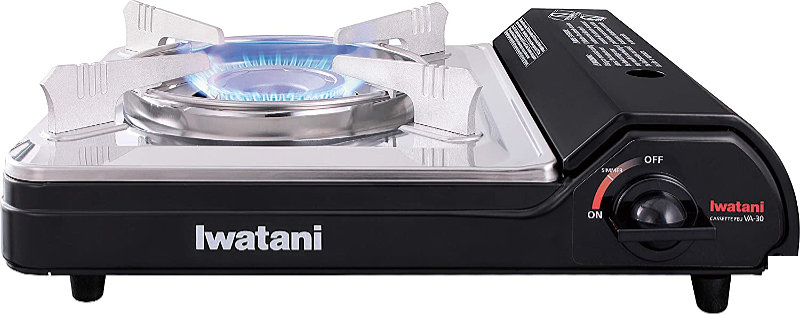
Iwatani VA-30
If I were choosing one butane stove for emergency backup cooking, indoor tabletop use where allowed by the manufacturer, and general reliability, the Iwatani VA-30 would be near the top of my list. It offers strong output, a clean design, and the kind of fit-and-finish that makes it more appealing than many low-cost alternatives.
Iwatani offers several models, but their VA-30 stands out as a mid-range priced, portable stove with a sleek design and a powerful 12,000 BTU burner.
Attributes Summary:
The Iwatani VA-30 is a strong “best overall” butane stove choice because it combines a useful 12,000 BTU/hr output with a quality, compact single-burner design and several built-in safety features.
Its best attributes are the pressure-sensing shutoff, which cuts fuel flow if canister pressure rises too high; the canister-setting safety mechanism, which helps prevent the canister from being attached unless the stove is off; a double O-ring receiving guide for a better seal; and an inverted drip-pan prevention feature.
It also has a practical windbreaker around the burner area, making it more useful for both tabletop/emergency cooking and some outdoor use.
In short, the VA-30 is not just a cheap backup burner. It is a higher-quality portable butane stove with better safety engineering than many generic models.
→ Check Price & Availability(Amazon)
Best Premium Upgrade
Iwatani 35FW
If you want to step up from a basic tabletop burner, the Iwatani 35FW is a strong premium option to consider. It is a better fit for readers who want a more robust cooktop feel and are willing to pay more for brand reputation and added refinement.
The 35FW outputs up to 15,000 BTU/hr, has a durable brass burner, a double windbreaker, an automatic safety stop, and a magnetic locking fuel canister system.
Attributes Summary:
The Iwatani 35FW is the higher-output premium pick, with a strong 15,000 BTU/hr solid brass burner, making it better suited than lower-output models for fast boiling, stir-fry, cast-iron preheating, and general emergency cooking where you want more heat.
Its best attributes are the magnetic locking system, which makes canister attachment simpler and helps prevent incorrect loading; the heat panel system, which helps maintain more consistent output as the fuel canister empties; the double windbreaker, useful around drafts, fans, air conditioning, or outdoor use; and its built-in safety features, including a pressure-sensing shutoff and a canister-setting safety mechanism that prevents attaching the canister unless the stove is off.
It also includes piezoelectric ignition and a carrying case, making it a powerful, well-built portable butane stove for those willing to pay more than budget models.
→ Check Price & Availability(Amazon)

Best Budget Pick
Gas One Portable Butane Stove
The Gas One remains a practical budget-friendly choice. It is widely available, simple, and has already proven itself as a useful emergency backup stove.
Years ago, I bought the GAS ONE butane stove and have used it many times. It was my first emergency stove purchase for preparedness. It served me well for travel, backup cooking, and emergency use.
Attributes Summary:
The Gas One portable butane stove is the budget-friendly choice, best suited for someone who wants an affordable emergency cooking backup without paying Iwatani prices.
Depending on the model, Gas One offers compact single-burner butane stoves in the roughly 7,650 to 10,000 BTU range, with common strengths including light weight, simple piezo ignition, use of standard 8 oz butane canisters, and a plastic carrying case for storage or transport.
The standout attribute is value: it is inexpensive, easy to store, and practical for occasional power-outage cooking, camping, or backup use.
Some Gas One models also include important safety features such as a cartridge ejection system, automatic safety shutoff, and a safety lever that prevents the canister from locking unless the dial is off, though the exact features vary by model.
→ Check Price & Availability(Amazon)

Best Butane Stove with Double Wind Screen
Outdoor/camping honorable mention, excelling for use outdoors, is the Iwatani Fore Winds.
Iwatani Fore Winds
With a double wind shield, the 11,000 BTU burner is designed to resist the wind. This makes it an especially nice butane camp stove for outdoor use. Another unique feature is how the fuel canister locks in place with magnetic locking for a safe seal and prevents fuel leaks. There is a pressure sensing device that auto-releases and disconnects the fuel can if unsafe heat levels are detected.
Attributes Summary:
The Iwatani Fore Winds Rugged Camp Stove is an outdoor/camping-oriented Iwatani option, with a durable enamel-coated steel body, sturdy aluminum legs, a wind-resistant multi-flame burner, and a double wind shield that helps protect the flame in breezy conditions.
It puts out 11,000 BTU/hr, uses standard Iwatani 8 oz butane canisters, includes piezoelectric ignition, has a magnetic locking system for easier and safer canister connection, and comes with a carrying case.
Its strongest attributes are rugged build quality, stability, and better wind performance than a basic tabletop butane stove. It is a great outdoor-capable / camp-use Iwatani
→ Check Price & Availability(Amazon)

Check for Recalls Before Buying a Butane Stove
Before buying any portable butane stove, check the current model number, read the manufacturer’s instructions, and look for active recalls. Portable butane stoves are simple appliances, but poor design, incorrect canister fitment, overheating, or using the wrong cookware can create a real fire or burn hazard.
This is one reason I prefer sticking with reputable brands and models with clear safety features, such as pressure shutoff protection, secure canister locking, stable pan support, and clear operating instructions.
Can You Use a Butane Stove Indoors?
Can you use a portable gas stove indoors? Sometimes, but only with important limitations. The better question is not just “Can you use a butane stove indoors?” but rather:
Which portable butane stoves are better choices for short-duration cooking, and what safety steps matter most?
Indoor-Rated vs. Outdoor-Only Butane Stoves
Not all portable butane stoves are the same. Some models are specifically designed and marketed for indoor tabletop cooking, while others are intended for outdoor use only. Always read the manufacturer’s instructions and labeling. A stove that is rated for indoor use, combined with proper ventilation and common-sense operation, is what makes the difference.
What Makes a Butane Stove a Better Indoor Choice?
If you are comparing the best portable gas stove for indoor use, look for these features first:
- Reliable ignition
- Secure canister lockup
- Pressure shutoff or overheat protection
- Stable base and good pan support
- Clear manufacturer guidance
- A strong reputation for consistent quality
Are butane burners safe indoors? Used responsibly, butane stoves are widely used indoors worldwide – especially in Asian households – and are considered one of the safer portable gas options available.
Before buying or using any portable butane stove, check the manufacturer’s instructions and look for current recall notices.
From a preparedness perspective, I recommend stocking up on butane canisters.
→ 12 Butane Fuel Canisters(Amazon)

Butane Stove Indoor Safety: Ventilation, Carbon Monoxide, and Fuel Storage
Why Butane Stoves Are Commonly Used Indoors
“The burning of ANY hydrocarbon produces CO ( Carbon Monoxide ) which can be deadly IF there is no exhaust or the inside ventilation is inadequate.”
Butane Burns Cleaner
Does a butane stove produce carbon monoxide? The good thing is that butane burns cleaner comparatively to other fuels.
The complete combustion of butane does not typically produce carbon monoxide, but rather carbon dioxide (CO2) and water vapor. However, not every burner produces 100% complete combustion.
“When oxygen is plentiful, butane burns to form carbon dioxide and water vapor;” (wikipedia)
CO is the result of incomplete oxidation. Can this happen with a butane stove? It is less likely than dirtier fuels under proper combustion, but still capable of producing CO if combustion is incomplete. However, this is why it’s essential to use high-quality stoves for indoor use and complete combustion.
Butane Canister Safety and Storage
Beyond ventilation, it’s also important to handle butane fuel safely. Butane is heavier than air, so any leaked gas can settle in low areas rather than rising and dispersing quickly. Always attach and remove canisters carefully, never store them near heat sources, and avoid using damaged or dented cartridges. Store spare canisters in a cool, well-ventilated area away from living spaces.
Use Common Sense
USE COMMON SENSE. CO is odorless. I wouldn’t use it in a tight, enclosed space without ventilation, and I would never use a butane stove as a heater!
Although butane burns cleaner than many portable fuels, indoor use should be approached cautiously. Follow the manufacturer’s instructions, use ventilation, and never assume all portable camp stoves are suitable for household indoor use.
Asian families commonly and regularly use a butane stove indoors for cooking. I’ve used my single-burner indoor butane stove many times without issue.
How to Use a Butane Stove Indoors Safely
If you plan to cook indoors with a butane stove, follow these basic safety steps:
- Use the stove in a well-ventilated area — never in a sealed room.
- Keep the stove on a stable, non-flammable surface away from curtains or clutter.
- Make sure the butane canister is properly seated and locked into place before lighting.
- Light the stove according to the manufacturer’s instructions — never force ignition.
- Never leave the stove unattended while it’s burning.
- Do not use the stove as a heater or for long-duration heating.
- Turn the stove off completely before removing the fuel canister.
- Keep a working carbon monoxide detector in your home.
Used this way, a butane stove can be a practical short-term cooking solution during power outages or emergencies.
With that said, and quite unlikely in a typical environment, “when oxygen is limited, carbon (soot) or carbon monoxide may also be formed.”
It’s always a good idea to be aware of ventilation in your space, especially if you’re cooking in a tiny area. A Carbon Monoxide Detector should be in every home! Why? Because you can’t smell carbon monoxide. This is the one that I use at home:
→ First Alert CO400 Carbon Monoxide Detector(Amazon)
👉 Carbon monoxide poisoning symptoms from indoor gas use

Butane vs Propane Stoves for Indoor Use
Is butane safer than propane indoors? Both butane and propane are commonly used portable cooking fuels, but butane generally burns cleaner and is more often used for indoor tabletop cooking worldwide. That said, neither fuel should ever be used without ventilation, and neither should be used as a heater. For short-duration cooking in a ventilated space, butane is typically considered the safer of the two.
Uses for an indoor-safe butane stove
What portable stove can be used indoors during a power outage?
When the power goes out, heat up a nice can of (fill in the blank) for dinner!
Again, there has been a power outage. It’s been out all night. I need hot coffee in the morning! Do you have a percolator for that?!
Road trip! I took mine cross-country. It served us well on the trip because we took lots of food (cans of this and that, etc.).
– Convenient for a camping trip. Not so much for backpacking, but a base camp, yes.
– Hunting camp. Fishing camp. You name it…
– Simply an emergency backup! And it’s often considered one of the cleaner portable cooking fuel options when used correctly.
Note: My experience using our butane stove is that it burns hot and heats food fast. The butane canisters last longer than I initially thought they would, and having a bunch of spare canisters on hand has proven to be a convenient backup. In a well-ventilated shed, I store them with my other fuel products outside the house.
👉 Thermal Slow Cooker Saves On Energy!
Frequently Asked Questions About Using a Butane Stove Indoors
A butane stove can be used indoors when it is designed for indoor-safe use and there is adequate ventilation. Butane burns cleaner than many other portable fuels, making it a safer choice for short-duration indoor cooking when used responsibly.
Butane stoves are considered one of the safer portable gas stove options for indoor use when compared to propane or white gas stoves. However, proper ventilation is essential, and the stove should never be used as a heat source.
Like all hydrocarbon fuels, butane can produce carbon monoxide if combustion is incomplete. However, butane burns very cleanly, and quality stoves operating with sufficient oxygen are far less likely to generate dangerous CO levels.
While a butane stove does not require special exhaust systems, it should always be used in a well-ventilated area. Avoid using it in tightly enclosed spaces.
In many cases, yes. Butane generally burns cleaner than propane and is commonly used indoors worldwide, especially in Asian households. That said, both fuels require ventilation and proper use to remain safe.
Yes. A butane stove is an excellent option for cooking during a power outage because it does not rely on electricity. It provides fast heat for boiling water, cooking meals, or making coffee when the grid is down.
Absolutely. A carbon monoxide detector should be installed in every home, regardless of stove type. Since CO is odorless and invisible, a detector is the only reliable way to identify unsafe levels.
>> Cooking without electricity is something everyone should consider in case of a power outage or other emergencies.
I have one and they do burn hot! Understand how a CO detector works, they do not detect the gas instantly like a smoke detector does. They will sound the alarm after enough accumulates, which might be too late? I prefer to trust normal, adequate ventilation and have never had a problem.